JSTOR Global Plants Home
  • Home
  • Browse
  • About
  • Access
  • Account
    • Saved Items
    • Profile
  • Log in

Global Plants

Skip to Main Content
  • JSTOR Global Plants Home
  • Global Plants

    • Browse
    • About
    • Access
    • Account
      • Saved Items
      • Profile
Log in
  • Browse
  • About
  • Access
  • Account
    • Saved Items
    • Profile
Advanced Search

Compilation
Portulaca kermesina

7 Images see all

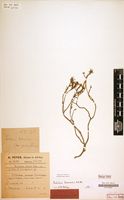
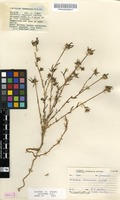
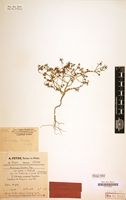
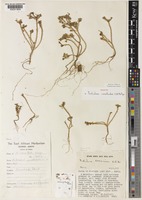
Isotype of Portulaca tenera Peter [family PORTULACACEAE]
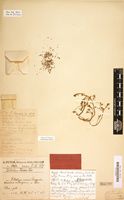
Paratype of Portulaca tenera Peter [family PORTULACACEAE]
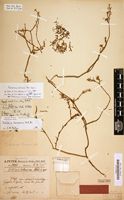
Holotype of Portulaca tenera Peter [family PORTULACACEAE]
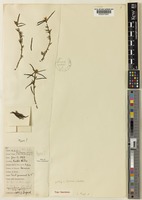
Type of Portulaca kermesina N.E. Br. [family PORTULACACEAE]
Filed as Portulaca kermesina N.E.Br. [family PORTULACACEAE]
Paratype of Portulaca tenera Peter [family PORTULACACEAE]
Portulaca coralloides S.M.Phillips [family PORTULACACEAE]
Previous
Next

Name

Identification
Portulaca tenera Peter [family PORTULACACEAE ] Verified by Not on sheet., Portulaca kermesina N.E.Br. [family PORTULACACEAE ] (stored under name); Verified by Not on sheet.,
Related name
  • Portulaca kermesina
  • Portulaca tenera

Flora

Entry for PORTULACA kermesina N.E. Br. [family PORTULACACEAE]
Herbarium
Royal Botanic Gardens, Kew (K)
Collection
Flora Somalia
Resource Type
Reference Sources
Entry From
Flora Somalia, Vol 1, (1993) Author: by M. G. Gilbert [updated by M. Thulin 2008]
Names
PORTULACA kermesina N.E. Br. [family PORTULACACEAE], (1909).
PORTULACA rubriflora Poelln. [family PORTULACACEAE], (1941) (” rubrifolia ” Cuf. Enum., 1953).
PORTULACA pilosa [family PORTULACACEAE], auct. Afric., ? non L. (1753).
Information
Erect or ascending annual, 8–15(–25) cm high, branching mainly near base, dried stem to 3(–4) mm thick. Leaves alternate, 4–12 x 0.6–1.4 mm, subterete, tip acute; axils usually with prominent tuft of pale brown to whitish hairs up to 5–6(–10) mm long, sometimes plus 2 or more darker narrow scales with strongly falcate bases (outside Flora area). Involucre of up to 6 leaf-like bracts 9–20 mm long plus a dense mass of brownish hairs. Flowers often more than 5 together. Sepals 3–5 mm long, fleshy, subacute. Petals 5, bright red or, less often, orange-red (? or pinkish-/purplish-red), up to 8 x 4 mm, shorter than involucre, tip obtuse to subacute. Stamens 10–15(–25). Stigma 3–4-lobed. Capsule base c. 0.5 mm deep, 2.5–3.5 mm diam.; lid cylindrical-hemispherical with prominent style base, c. 2.5 mm high, glossy straw yellow, fragile. Seeds 0.6–0.65 mm long, dark grey, usually brightly iridescent; testa cells domed to conical with stellate-sinuate margins.
Range
S1–3 Sudan, S Ethiopia, ?Uganda, Kenya south to Botswana and Transvaal.
Altitude range
30–230 m.
Distribution
SOMALIA Alstrup & Michelsen 100; Bally 9364; Deshmukh JESS 403.
Notes
The flower colour is diagnostic for this species as far as is known. Material from further south has rather more prominently hairy axils. This species is possibly conspecific with P. anceps A. Rich. (1847), known only from the type from Ethiopia. P. anceps supposedly differs by the “purple” flowers and fewer involucral leaves, but these could well prove not to be real differences. P. fischeri Pax (1893) is also closely related. It is supposed to differ by having capsules that split half way down, not well below the middle as is the case with most member of this complex. The difference is very slight and needs investigating further. It could well be that P. fischeri will have to include P. kermesina.

Related Materials

  • Terms and Conditions
  • Privacy Policy
  • Cookie Policy
  • Cookie Settings
  • Accessibility
  • Help
  • Contact Us
  • Facebook
  • Twitter
ITHAKA

JSTOR is part of ITHAKA, a not-for-profit organization helping the academic community use digital technologies to preserve the scholarly record and to advance research and teaching in sustainable ways.

©2000-2026 ITHAKA. All Rights Reserved. JSTOR®, the JSTOR logo, JPASS®, Aluka®, and ITHAKA® are registered trademarks of ITHAKA.

╳