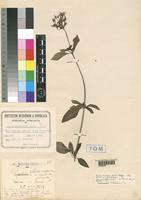
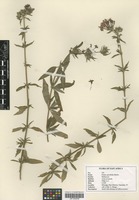
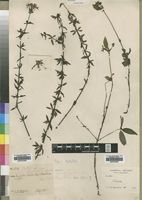
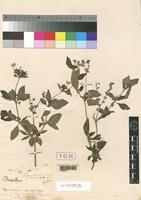
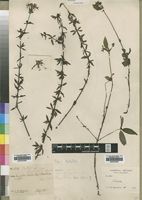
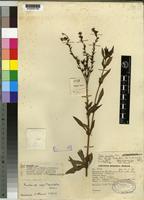
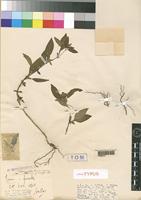
Subshrub 0.6–2.5 m. tall, with erect or straggling often irregularly branched stems but not a true liane; in straggling forms the branches are frequently very unequally developed on opposite sides of a node; stems pale or purplish brown, woody, pubescent with white or ferruginous hairs above, glabrous below and the epidermis often peeling. Leaf-blades elliptic-lanceolate, ovate-lanceolate or oblong-elliptic, 1.2–9(–10.5) cm. long, 0.3–0.8(–2) cm. wide, acute at the apex, cuneate at the base, glabrescent to pubescent above, with fine white pubescence beneath; petiole 0–6 mm. long; stipules with 5–9 setae up to 6 mm. long from a brown base up to 4 mm. long. Inflorescence terminal, combined with axillary ones from the apical node, mostly 2–3 cm. wide, often only few-flowered; in one form the branches are distinctly spicate. Flowers scarlet, rarely pink and white, mostly dimorphic, but sometimes practically trimorphic. Calyx-tube obovoid, ± 1.5 mm. long and wide, glabrous to velutinous; lobes 5–6, unequal, the largest 0.3–1.2 cm. long, 0.7–2(–6) mm. wide, the rest short, 1.5 mm. long. Short-styled flowers; corolla-tube 0.7–1.8(–2.2) cm. long, 0.7 mm. wide, gradually dilated to 1–2 mm. at the apex; lobes oblong to linear-oblong, 2.5–10 mm. long, 1–3.3 mm. wide, glabrous or pubescent outside; stamens with anthers well exserted or rarely almost included; throat densely hairy. Long-styled flowers similar; corolla-tube enlarged cylindrically at apex to 1.5–5 mm. for a distance of 2–4 mm.; style exserted 1–6 mm.; stigma 2–2.5 mm. long; stamens completely included. Capsules as in P. bussei.