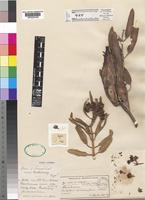
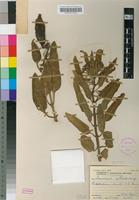
stems apparently about 6–10 in. high, 2–3 lin. thick, bifariously puberulous, leafy to the base; leaves spreading or ascending; petiole 1/3– 3/4 in. long, channelled and puberulous above; blade 1 1/2–3 1/3 in. long, 2 1/2–10 lin. broad, oblong, lanceolate-oblong or oblong-linear, acute, rounded or cuneate at the base, coriaceous, flat, not crisped at the margins, glabrous on both sides; umbels 4–6, lateral at the nodes, pedunculate, 8–9-flowered; peduncles 1/4–1 in. long, moderately stout, puberulous on one side; bracts 2–3 lin. long, linear-subulate, finely pointed, glabrous, minutely and sparsely ciliate; pedicels 1/3– 1/2 in. long, puberulous on one side; sepals 1/4 in. long, 3/4–1 lin. broad, lanceolate, acuminate, with a few hairs on the back or subglabrous, applied to the corolla, with spreading tips; corolla subglobose-campanulate, quite glabrous, “creamy-brown” according to Miss Pegler, dark purple-brown with pale margins to the lobes in the dried state; tube 1–1 1/4 in. long; lobes about 3 lin. long, erect and contiguous at the very concave lower part, recurved at the flat tips, revolute along the margins; corona-lobes arising just below the sinuses between the corolla-lobes and decurrent-adnate to the bottom of the corolla, 3/4 lin. high, 1 1/3 lin. broad, transversely oblong, subtruncately rounded at the top, which has an acute edge, fleshy, white, erect, contiguous at their sides, which are slightly reflexed, forming a pentagonal cup surrounding, but free from, the 2 lin. long staminal column; anther-appendages ovate, with the margins recurved as if pinched just below the truncate apex, erect, applied to the sides of the style-apex; anther-wings triangular in outline, acute at the apex and not 1/4 as broad just below as at the acutely hooked-angular base, nearly straight on their outer margin; style-apex shortly columnar or subconical, minutely bilobed, not exserted beyond the anther-appendages; follicle solitary, erect, very large in proportion to the plant, 5 in. or more long, 1 in. thick, lanceolate, truncate and somewhat toothed at the apex, with about 5 coriaceous irregularly toothed wings, teeth 1/8– 1/4 in. long; seeds (unripe) ovate, very concave on one side, convex on the other, rugose, dark brown, probably about 2 lin. long when ripe. null