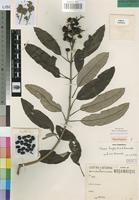
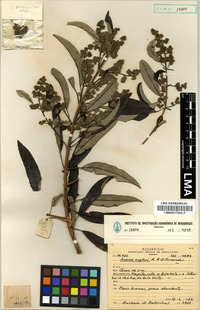
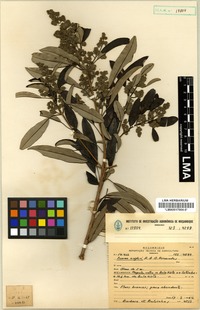
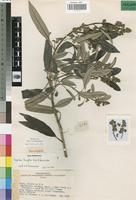
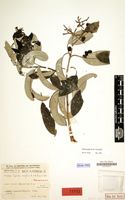
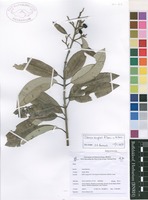
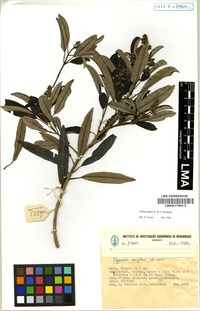
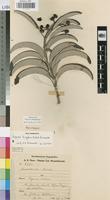
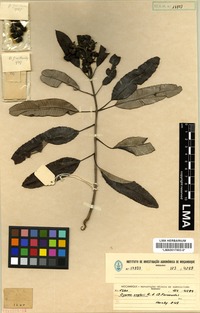
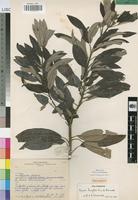
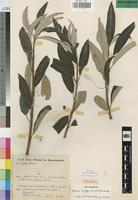
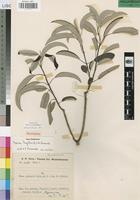
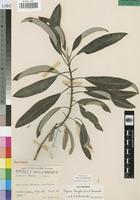
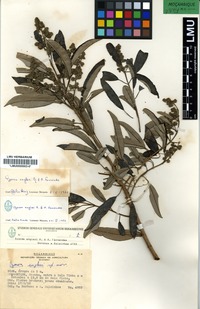
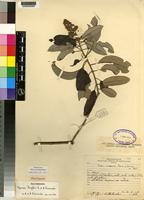
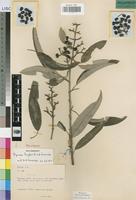
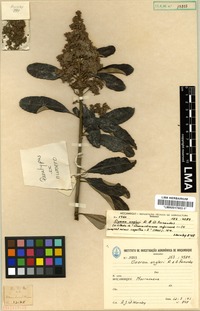
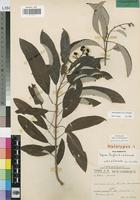
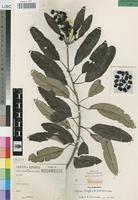
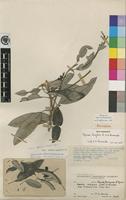
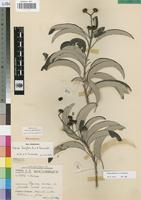
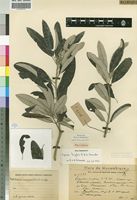
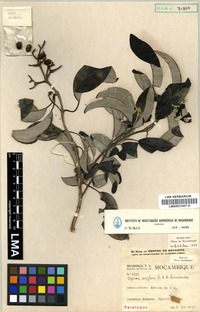
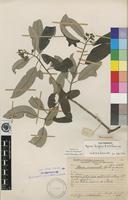
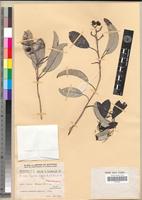
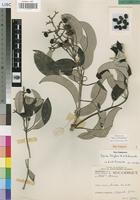
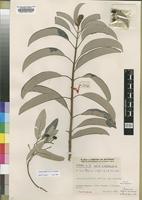
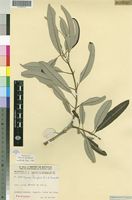
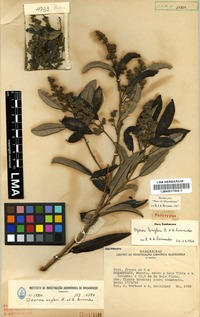
Small tree 6–8 m. tall or a robust shrub; branches with many densely leafy branchlets, brownish- or reddish- or greyish-appressed-puberulous to glabrescent, cylindric, slightly striate on the lower parts, a little more striate or sulcate on the upper parts. Leaves alternate or the uppermost ones subverticillate or verticillate; petiole 1–3 cm. long, slender, dorsally convex, flattened near the base and narrowly furrowed to the apex on the upper surface, from cinnamon-coloured to dark brown, very sparsely and appressed-pilose, rarely with somewhat longer patent hairs; lamina very discolorous (dark green to nearly black and glabrous on the upper surface, distinctly cinereous when young, sometimes greyish-green when older on the under surface, i.e. densely covered by minute very appressed hairs), 4–14 × 1–3·3 cm., oblong to narrowly elliptic, narrowing to both ends, frequently folded and arched at the midrib, attenuate to acute (rarely rounded) and mucronate at the apex, with slightly thickened frequently undulate margin, usually acute at the base, membranous to papyraceous; midrib a little impressed above, very prominent beneath; lateral nerves very slender, not or only slightly raised above, darker-coloured than the lamina, sparsely appressed-puberulous and not at all raised below, 1·5–4 mm. apart in the median part of lamina, rather regularly forked at 2–2·5 mm. from the margin; reticulation invisible on both surfaces. Panicles terminal and axillary, the later shorter than the leaves, with cinereous sulcate axis and branches, the male ones very dense; pedicels 1–1·5 mm. long. Calyx-segments c. 1 × 1 mm., ovate-triangular, minutely appressed-pilose. Petals c. 3 × 1·25 mm., hairy like the calyx. Drupe black, somewhat shining, 6·5–8 × 9·5–12 × 4·5–5 mm., transversally ellipsoid, compressed.