

Compilation
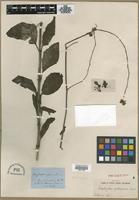
Oxybaphus pauciflorus
1 Images see all
Name
Identification
Oxybaphus pauciflorus Buckley [family NYCTAGINACEAE ] (stored under name); Verified by Not on sheet, Oxybaphus pauciflorus Buckley [family NYCTAGINACEAE ] Verified by Unknown, Oxybaphus nyctagineus (Michx.) Sweet [family NYCTAGINACEAE ] Verified by Unknown,
Related name
- Oxybaphus nyctagineus
- Oxybaphus pauciflorus
Flora
Entry for Mirabilis albida (Walter) Heimerl [family NYCTAGINACEAE]
Herbarium
Flora of North America (FNA)
Collection
Flora of North America
Resource Type
Reference Sources
Entry From
Flora of North America, Vol 4,
Names
Mirabilis albida (Walter) Heimerl [family NYCTAGINACEAE], Annuaire Conserv. Jard. Bot. Genève, 5 : 182. 1901
Allionia albida Walter [family NYCTAGINACEAE], Fl. Carol., 84. 1788
Allionia coahuilensis Standley [family NYCTAGINACEAE]
Allionia comata Small [family NYCTAGINACEAE]
Allionia divaricata Rydberg [family NYCTAGINACEAE]
Allionia hirsuta Pursh [family NYCTAGINACEAE]
Allionia oblongifolia (A. Gray) Small [family NYCTAGINACEAE]
Allionia pauciflora (Buckley) Standley [family NYCTAGINACEAE]
Allionia pratensis Standley [family NYCTAGINACEAE]
Allionia pseudaggregata (Heimerl) Standley [family NYCTAGINACEAE]
Allionia pumila Standley [family NYCTAGINACEAE]
Mirabilis ciliata (Standley) Standley [family NYCTAGINACEAE]
Mirabilis coahuilensis (Standley) Standley [family NYCTAGINACEAE]
Mirabilis comata (Small) Standley [family NYCTAGINACEAE]
Mirabilis eutricha Shinners [family NYCTAGINACEAE]
Mirabilis grayana (Standley) Standley [family NYCTAGINACEAE]
Mirabilis hirsuta (Pursh) MacMillan [family NYCTAGINACEAE]
Mirabilis lanceolata (Rydberg) Stan dley [family NYCTAGINACEAE]
Mirabilis oblongifolia (A. Gray) Heimerl [family NYCTAGINACEAE]
Mirabilis pauciflora (Buckley) Standley [family NYCTAGINACEAE]
Mirabilis pseudaggregata Heimerl [family NYCTAGINACEAE]
Mirabilis pumila (Standley) Standley [family NYCTAGINACEAE]
Oxybaphus albidus (Walter) Sweet [family NYCTAGINACEAE]
Oxybaphus coahuilensis (Standley) Weatherby [family NYCTAGINACEAE]
Oxybaphus comatus (Small) Weatherby [family NYCTAGINACEAE]
Oxybaphus hirsutus (Pursh)S weet [family NYCTAGINACEAE]
Oxybaphus pauciflorus Buckley [family NYCTAGINACEAE]
Oxybaphus pseudaggregatus (Heimerl) Weatherby [family NYCTAGINACEAE]
Oxybaphus pumilus (Standley) Standley [family NYCTAGINACEAE]
Treatment Author(s)
Richard W. Spellenberg
Information
Stems 1–many, erect to decumbent, few or highly branched, sparsely to densely leafy in basal 1/2 or throughout, 0.8–15 dm, glabrous to puberulent basally in 2 lines or throughout, hairs often awned, or stems villous and often viscid, or sometimes hirsute, hair types often mixed, spreading pubescent. Leaves ascending to spreading at 10–90°; petiole 0–4 cm; blade green to glaucous blue-gray, linear-lanceolate to ovate-lanceolate, ovate, or deltate, 1–11 × 0.6–2.5 cm in lanceolate leaves, 2–9 × 1–6.5 cm in ovate leaves, thin and fleshy to thick and coriaceous, base cuneate to round, truncate, or cordate, apex acute, obtuse, or round, surfaces glabrous or viscid-puberulent, viscid-villous, or hirsute. Inflorescences axillary or terminal, few branched, ± evenly forked and open, or, when axillary, often consisting only of single involucres (and then flowers commonly cleistogamous); peduncle 1–25 mm, puberulent with curled hairs, hispid, villous, or viscid-villous, crosswalls of hairs pale; involucres pale green or sometimes blushed with purple when young, widely bell-shaped, 4–7 mm in flower, 5–15 mm in fruit, sparsely to densely pubescent with small curled hairs or long spreading hairs, often viscid, 50–80% connate, lobes ovate, triangular-ovate, broadly ovate, or occasionally round. Flowers (1–)3 per involucre; perianth white, pink, or deep red-violet, 0.8–1.5 cm. Fruits brown to dark brown with pale tan, brown, or dark brown ribs, obovoid to narrowly obovate and tapering at both ends, 3.5–5.5 mm, pubescent with tufted spreading hairs 0.1–0.5 mm, with or without minute glandular hairs; ribs round or round-angled, (0.3–)0.7–1.5 times width of sulci, 0.5–1 times as wide as high, with tall shelflike tubercles (eastern part of range), smooth or somewhat rugose or moderately tuberculate (western part of range); sulci with prominent, pale, shelflike tubercles (eastern), minutely rugose or with small low warts (western). 2n = 58.
Phenology
jun-aug (summer), sep-nov (fall)
Altitude range
0–2600 m;
Distribution
Mexico.USA Ala.USA Ariz.USA Ark.USA Calif.USA Colo.USA Conn.USA Ga.USA Ill.USA Ind.USA IowaUSA Kans.USA Ky.USA La.USA MaineUSA Mass.USA Mich.USA Minn.USA Miss.USA Mo.USA Nebr.USA Nev.USA N.J.USA N.Mex.USA N.Y.USA N.Dak.USA OhioUSA Okla.USA Pa.USA S.C.USA S.Dak.USA Tenn.USA Tex.USA UtahUSA Wis.USA Wyo.Canada Alta.Canada B.C.Canada Man.Canada Ont.Canada Que.Canada Sask.
Discussion
In the eastern half of the continent, Mirabilis albida is reasonably uniform, usually erect, with lanceolate or narrowly oblong leaves, and fruits with large, wartlike tubercles on ribs and sulci. These fruits are very similar to those of M. nyctaginea, except they are usually yellowish brown rather than reddish brown. On the western plains, M. albida intergrades with M. linearis. R. Spellenberg (1998), in attempting to maintain a fairly uniform M. albida, provided a table distinguishing among it, M. oblongifolia, and M. melanotricha. Distinguishing leaf forms of M. oblongifolia as circumscribed by C. F. Reed (1969) from western races of M. albida becomes untenable, as proposed by B. L. Turner (1993b). Individual specimens are sometimes very different, but in a series of populations distinctions merge. The minute glandular hairs beneath the tufts of larger hairs and the presence of large, shelflike tubercles are fairly consistent throughout the eastern half of the continent. In the southwestern mountains, where M. oblongifolia in the broad sense occurs, and in the northern Rocky Mountains, where M. lanceolata occurs (as these phases in the complex have been named), both features are either inconsistent or absent, the fruits becoming much less warty and more like those of M. linearis. Some phases, such as M. comata, and Allionia pratensis, seem to form reasonably recognizable geographically and ecologically restricted populations and may be worthy of taxonomic recognition, perhaps at the infraspecific level. The type of M. hirsuta has the general form of broad-leaved plains races of M. albida is lightly hispid on basal parts. The exceedingly hispid, broad-leaved forms commonly identified as M. hirsuta from near the eastern base of the Rocky Mountains are here recognized as M. rotundifolia; the hispid narrow-leaved phases from the southwestern plains are included within M. linearis.