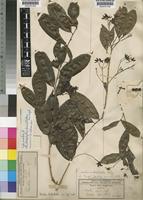
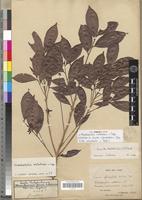
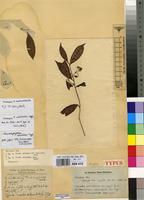
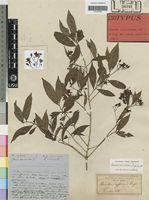
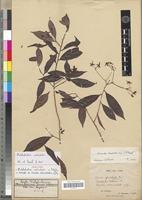
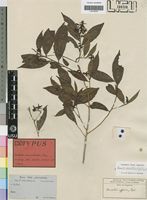
Shrub or small tree (1) 2–5 m. high, much branched, with bark grey-brown, closely longitudinally fissured and with transverse cracks; branches slender, green and striate at first, becoming pale or purplish-brown. Leaves petiolate; lamina (5) 5·9–12·2 (14·5) × (1·5) 2·2–4 (5) cm., elliptic to oblanceolate or oblong, acute (rarely subobtuse) or acutely acuminate (with acumen up to 1 cm. long) at the apex, with margin undulate-serrulate to (rarely) subentire, cuneate at the base, chartaceous to subcoriaceous, with lateral nerves and veins very numerous, close together and parallel or almost so, scarcely prominent; petiole (1) 2–4 (5) mm. long, slender or rather stout; stipules 1–3 mm. long, free, intrapetiolar, partly or completely united, soon deciduous or persisting for 1–2 years. Flowers 4–18, in compound, paniculate or pseudumbellate racemes 1·5–7 cm. long borne in axils of caducous scale leaves at the base of current growth; bracteoles caducous; peduncle variable in length, subterete or ± compressed; pedicels c. 10–23 mm. long in fruit, longer than the sepals, articulated in the lower 1/4 (rarely at the base). Sepals 5·5–7 mm. long in flower, narrowly elliptic to oblong, acute, occasionally with a small subapical tooth, becoming deep pink or red, 7–8·5 mm. long and spreading in fruit. Petals yellow, 6–8 × 2–3 mm., elliptic-oblong. Stamens with anthers 5–5·5 mm. long, orange, rugose or papillose. Carpels 5. Drupelets 5–6 × 4–5 mm., globose or obovoid, dorsally carinate when dry.