JSTOR Global Plants Home
  • Home
  • Browse
  • About
  • Access
  • Account
    • Saved Items
    • Profile
  • Log in

Global Plants

Skip to Main Content
  • JSTOR Global Plants Home
  • Global Plants

    • Browse
    • About
    • Access
    • Account
      • Saved Items
      • Profile
Log in
  • Browse
  • About
  • Access
  • Account
    • Saved Items
    • Profile
Advanced Search

Compilation
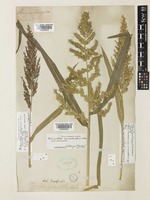
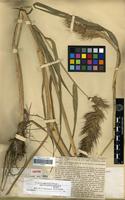
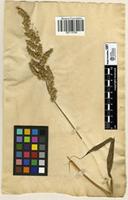
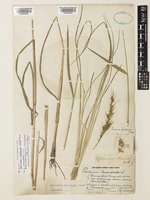
Oplismenus crus-galli

16 Images see all

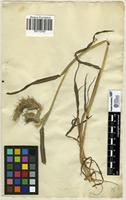
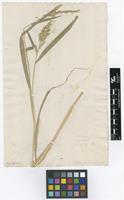
Neotype of Orthopogon subverticillatus Llanos [family POACEAE]
Echinochloa muricata (P.Beauv.) Fernald var. muricata [family POACEAE]
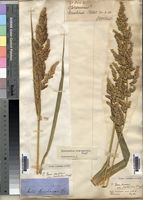
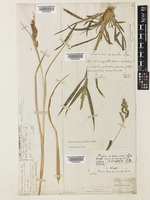
Echinochloa crus-pavonis (Kunth) Schult. [family POACEAE]
Echinochloa colona (L.) Link [family POACEAE]
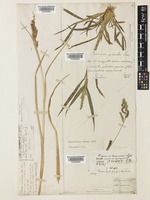
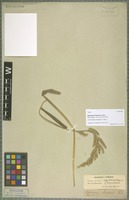
Echinochloa oryzoides (Ard.) Fritsch [family POACEAE]
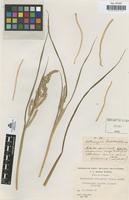
Filed as Panicum crus-galli L. [family POACEAE]
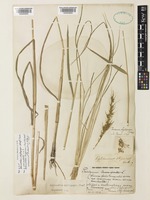
Echinochloa crus-pavonis (Kunth) Schult. [family POACEAE]
Echinochloa colona (L.) Link [family POACEAE]
Isotype of Orthopogon subverticellatus Llanos [family POACEAE]
Filed as Oplismenus crus-galli Kunth [family POACEAE]
Echinochloa oryzoides (Ard.) Fritsch [family POACEAE]
Filed as Oplismenus crus-galli Kunth [family POACEAE]
Syntype of Panicum crus-parvonis unrecorded var. rostratum Stapf [family POACEAE]
Echinochloa muricata (P.Beauv.) Fernald var. muricata [family POACEAE]
Type of Oplismenus limosus J. Presl [family POACEAE]
Holotype of Orthopogon hispidus Llanos [family GRAMINEAE]
Previous
Next

Name

Identification
Echinochloa crus-parvonis (Kunth) Schult. [family POACEAE ] (stored under name); Verified by Stapf, O., Panicum crus-parvonis unrecorded [family POACEAE ] Oplismenus crus-galli (L.) Dum. [family POACEAE ] Echinochloa crus-galli (L.) P.Beauv. [family POACEAE ]
Related name
  • Oplismenus crus-galli
  • Echinochloa crus-pavonis
  • Panicum crus-galli
  • Panicum crus-parvonis
  • Echinochloa crus-parvonis
  • Echinochloa crus-galli
  • Panicum crus-pavonis

Flora

Entry for PANICUM Crus-galli Linn. [family POACEAE]
Herbarium
Royal Botanic Gardens, Kew (K)
Collection
Flora Capensis
Resource Type
Reference Sources
Entry From
Flora Capensis, Vol 7, page 310, (1900) Author: (By O. STAPF.)
Names
PANICUM Crus-galli Linn. [family POACEAE], Sp. Plant. 56;—Fl. Dan. t. 1564; Host, Gram. Austr. ii. 15, t. 19; Engl. Bot. t. 876; Knapp, Gram. Britt. xi.; Trin. Sp. Gram. Ic. t. 161, 162; Nees. Fl. Afr. Austr. 58; Steud. Syn. Pl. Glum. i. 47; Durand & Schinz, Consp. Fl. Afr. v. 744 (excl. var.).
PANICUM hispidulum Nees [family POACEAE], Fl. Afr. Austr. 57, and Durand & Schinz, Consp. Fl. Afr. v. 750 (the African plant, excl. syn.).
Echinochloa Crus-galli Beauv. [family POACEAE], Agrost. 161; Reichb. Ic. Fl. Germ. i. t. 29, fig. 1411, 1412.
Oplismenus Crus-galli Dumort. [family POACEAE], Agrost. Belg. 138; Kunth, Rév. Gram. i. 44; Enum. i. 143 (excl. syn. P. zonale).
Information
annual; culms geniculately ascending, compressed below, 1–3 ft. high, glabrous, smooth, 3–5-noded, sheathed all along or the internodes at length more or less exserted, often branched below; sheaths striate, smooth, the lower often strongly compressed, whitish, glabrous except the lowest which are pubescent at the very base; ligules 0, junction of blade and sheath glabrous inside; blades linear from a scarcely narrowed base, tapering to an acute point, 3–8 in. by 3–6 lin., flat, subflaccid, glabrous, more or less glaucous, smooth above, scaberulous below, particularly towards the tip, margins finely cartilaginous, scabrid to almost smooth, midrib narrow; panicle erect, strict, or flexuous, 3–8 in. long; axis triquetrous, 3–5-angled, scabrid; branches few to about 15, solitary or 2-nate, suberect or spreading, distant except the uppermost, the lower 1–2 1/2 in. long, forming rather stout, dense, simple or subsimple, subsecund, sessile false spikes; rhachis triquetrous, scabrid, coarsely bristly, particularly near the nodes; pedicels fascicled or 2-nate, very short, up to 1/2 lin. long, scabrid, bristly at the base, tips obscurely discoid; spikelets crowded, ovoid-ellipsoid, cuspidate, 1 1/4–1 1/2 lin. long, greenish or tinged with purple; lower glume membranous, very broadly ovate, clasping at the base, obtuse to subcuspidate, 1/2 lin. long, 5-nerved, scaberulous; upper glume herbaceous-membranous, very broadly ovate-oblong, concave, acute or cuspidate, 1 1/2 lin. long, 5- or (near the tips) 7-nerved, rigidly pubescent between the scabrid and spinulous nerves; lower floret barren; valve similar to the upper glume, but flat or depressed on the back; cuspidate or produced into a scabrid, often long, awn, 7-nerved throughout or only towards the tips; pale elliptic, shorter by 1/4 than the valve, keels scaberulous above; hermaphrodite floret elliptic-ovate, cuspidate, over 1 lin. long, whitish or yellowish, smooth; valve subcoriaceous, 5-nerved; anthers oblong, scarcely 3/8 lin. long; grain broadly elliptic, 3/4 lin. long. null
Distribution
CENTRAL REGION Richmond Div.; Styl Kloof, in the Winter Veld, near Richmond, Drège! Somerset Div.; near the Blyde River, Burchell, 2968!COAST REGION Cape Div.; Lion Mountain, Drège! near Rondebosch, Ecklon. Near Claremont, Dod, 2423! Uitenhage Div.; near the Zwartkops River, Ecklon & Zeyher! Knysna Div.; Knysna Forests, E.S.C.A. Herb. 308! Queenstown Div.; moist spots near Shiloh, 3500 ft., Baur, 889!EASTERN REGION Natal; near Durban, Williamson, 13!
Notes
The typical form of P. Crus-galli, as described above, occurs as a weed throughout the temperate zones of both hemispheres, and more rarely in the tropics. All the South African specimens belong to the muticous state, except that collected by Baur near Shiloh. In Burchell's specimen (2968), the junction-line of blade and sheath is perfectly glabrous as usual, with the exception of one leaf where it is pubescent. I have not met with another case of this kind in the very numerous specimens of P. Crus-galli I have examined.

Related Materials

  • Terms and Conditions
  • Privacy Policy
  • Cookie Policy
  • Cookie Settings
  • Accessibility
  • Help
  • Contact Us
  • Facebook
  • Twitter
ITHAKA

JSTOR is part of ITHAKA, a not-for-profit organization helping the academic community use digital technologies to preserve the scholarly record and to advance research and teaching in sustainable ways.

©2000-2026 ITHAKA. All Rights Reserved. JSTOR®, the JSTOR logo, JPASS®, Aluka®, and ITHAKA® are registered trademarks of ITHAKA.

╳