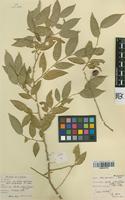
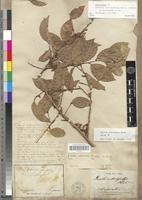
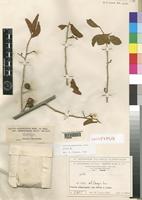
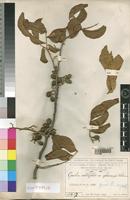
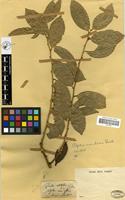
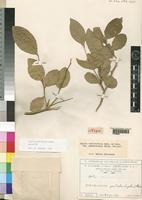
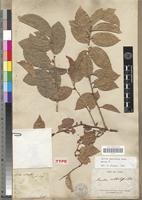
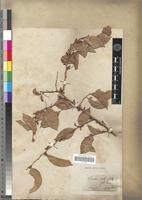
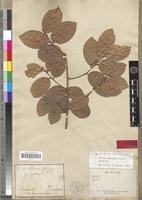
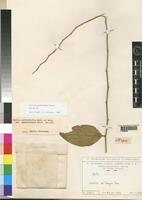
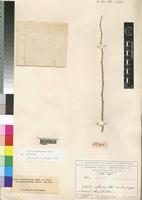
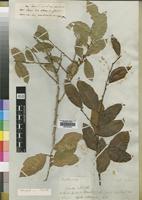
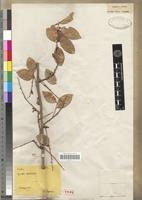
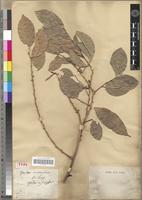
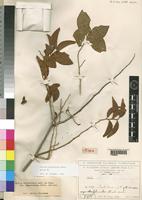
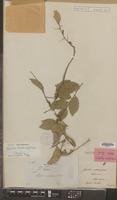
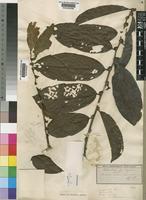
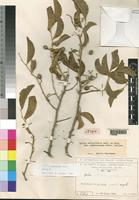
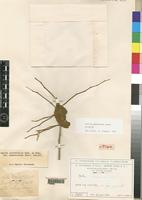
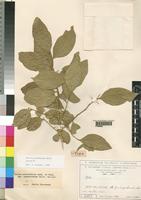
Scandent evergreen shrub, sometimes erect, up to 10 m. high, branching from near the base. Young branches usually green, sometimes reddish, glabrous to tomentellous; older bark grey to dark brown; lenticels paler, anastomosing to form shallow longitudinal ridges of cork. Petiole 3–8 mm. long; leaf-blade lanceolate to ovate or elliptic, 5–12 cm. long, 2–5 cm. wide, acute or bluntly acuminate to rounded, cuneate to more or less rounded at the base, coriaceous, more rarely chartaceous, glabrous to tomentellous; upper surface glossy, often covered with raised dots between tertiary veins (caused by cystoliths) or slightly tomentellous on both surfaces; secondary veins 2–7(–8) pairs. Inflorescence axillary, racemose, solitary or clustered (fasciculate), at first compact (cone-like in appearance), and covered with peltate imbricate caducous slightly pubescent bracts, ultimately extending up to 5.5 cm. long (catkin-like); peduncle pubescent; pedicels inserted in groups or solitary, pubescent with indumentum varying from yellowish-green to rust-brown. Flowers small, 5-merous, sweet-scented. Petals cream to yellowish-green, oblong-lanceolate, up to 2 mm. long, 0.7 mm. wide. Stamens up to 2 mm. long, basally attached to petals, sometimes free; filaments filiform. Fleshy disk-glands exposed by the recurving petals, truncate, under 1 mm. high. Ovary conical; style truncate. Fruit a drupe, ellipsoid, puberulous to shortly tomentellous, up to 2.5 cm. long and 1.4 cm. across, yellow to orange when ripe. Stone large, up to 1.8 mm. long and 1.2 mm. across.