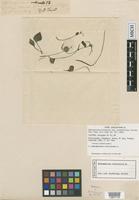
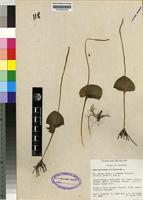
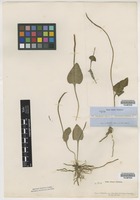
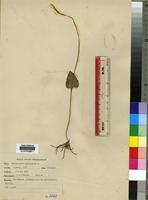
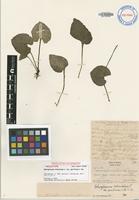
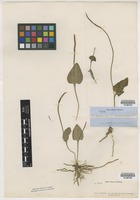
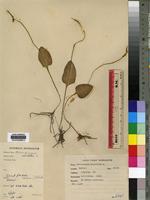
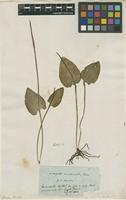
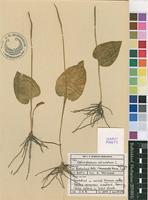
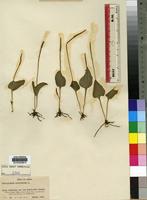
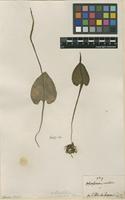
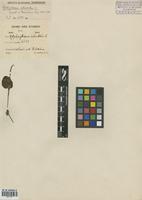
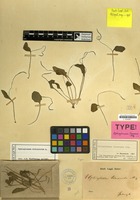
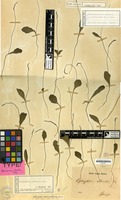
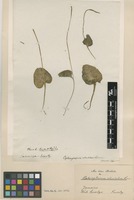
Perennial herb with deciduous (rarely evergreen) aerial parts. Rhizome fusiform to shortly linear, (5–)10–18(–28) mm long, (2–)2.5–4(–6) mm wide; roots few, fleshy, horizontal, sometimes descending, proliferous. Leaves 1 or 2, rarely 3; stipe (25–)43–131(–145) mm long, 35–60% of its length subterranean, stipe:lamina length ratio 2.1–1.5:1, stipe bases not persistent; lamina bright green, fertile lamina held at 10–50° from the ground, sterile lamina held at 50–80°, broadly ovate, rarely subglobose, fertile lamina usually partially folded, sterile lamina almost flat to slightly concave medially, (20–)24–77(–107) mm long, (14–)20–56(–67) mm wide, length:width ratio <1.5:1, apex acute to obtuse, usually apiculate, base cordate, more rarely truncate, fertile laminar with undulate margins, sterile laminar with flat margins; venation isodiametric marginally and distally, becoming elongate proximally and medially, secondary and blind veins numerous laterally; epidermal cells sinuous, shape as for veins; stomata not aligned laterally, partially aligned medially. Fertile spike (49–)99–204(–252) mm long, fertile spike:lamina length ratio 2.2–4.1:1, with (15–)21–34(–47) pairs of sporangia. Spores of two types; forma 1: equatorial diameter 42–50 µm, alete, muri granular, very broken, multi-layered and irregular, with deep irregular lumina, both surfaces patterned except for the sunken, smooth disc in the centre of the proximal face; forma 2: equatorial diameter 25–38 µm, trilete, finely reticulate, muri uneven, lumina subconical, pitted. Chromosome number (extra-African): n = 435–570. Fig. 2/5 (p. 7).