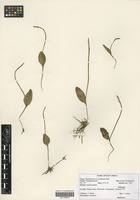
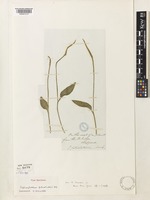
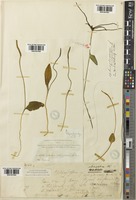
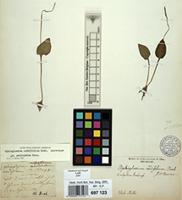
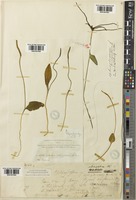
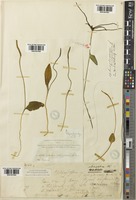
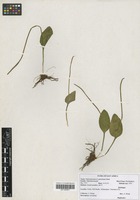
Ophioglossum cordifoliumRoxb. [family OPHIOGLOSSACEAE ] Verified by Not on sheet, Ophioglossum petiolatumHook. [family OPHIOGLOSSACEAE ] (stored under name); Verified by Morton C.V., 1970
Related name
Ophioglossum cordifolium
Ophioglossum petiolatum
Common name
Stalked adder's-tongue, Flora of North America Vol. 2
Flora
Entry for Ophioglossum petiolatum Hooker [family OPHIOGLOSSACEAE]
Roots dark brown, to 8 per plant, 0.8-1.3 mm diam., producing proliferations. Stem upright, 0.3-1 cm, 1.5-2.5mm diam., 2-3 leaves per stem. Trophophore stalk 0-3mm, 0-0.1 times length of blade. Trophophore blade erect to spreading, usually plane or nearly so when alive, gray-green, dull, ovate to trowel-shaped, to 6 × 3cm, fleshy, cuneate to truncate to nearly cordate at base, contracted gradually to acute apex, apiculum mostly absent; venation coarse, reticulate, areoles large with few free or anastomosing included veinlets. Sporophores arising at ground level, 0.8-7 times length of trophophore; sporangial clusters to 4 × 0.35 cm, with up to 30 pairs of sporangia, apiculum 0.3-1.2 mm.
Phenology
Leaves appearing during wet periods
Altitude range
0-90m
Distribution
West IndiesMexicon South AmericaAsiaPacific Islands.USA Ala.USA Ark.USA Fla.USA Ga.USA La.USA Miss.USA Mo.USA N.C.USA Okla.USA S.C.USA Tex.USA Va.
Discussion
Ophioglossum petiolatum grows readily in pots, making it suitable for botany instruction. Earliest records in North America date from 1900 to 1930, suggesting that it is probably introduced.