JSTOR Global Plants Home
  • Home
  • Browse
  • About
  • Access
  • Account
    • Saved Items
    • Profile
  • Log in

Global Plants

Skip to Main Content
  • JSTOR Global Plants Home
  • Global Plants

    • Browse
    • About
    • Access
    • Account
      • Saved Items
      • Profile
Log in
  • Browse
  • About
  • Access
  • Account
    • Saved Items
    • Profile
Advanced Search

Compilation
Ophioglossum latifolium

6 Images see all

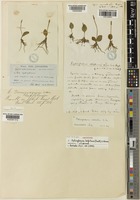
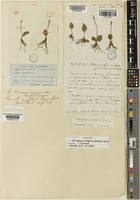
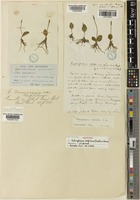
Lectotype of Ophioglossum latifolium (Prantl) J.E.Burrows [family OPHIOGLOSSACEAE]
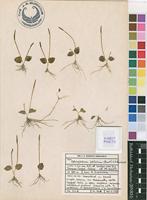
Filed as Ophioglossum latifolium (Prantl) J.E.Burrows [family OPHIOGLOSSACEAE]
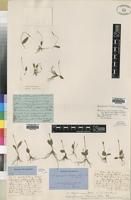
Type? of Ophioglossum ellipticum Welw. [family OPHIOGLOSSACEAE]
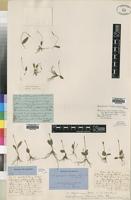
Ophioglossum latifolium (Prantl) J.E.Burrows [family OPHIOGLOSSACEAE]
Previous
Next

Name

Identification
Ophioglossum ellipticum Welw. [family OPHIOGLOSSACEAE ] Ophioglossum latifolium (Prantl) J.E.Burrows [family OPHIOGLOSSACEAE ] (stored under name);
Related name
  • Ophioglossum ellipticum
  • Ophioglossum latifolium

Flora

Entry for OPHIOGLOSSUM latifolium (Prantl) J.E. Burrows [family OPHIOGLOSSACEAE]
Herbarium
Royal Botanic Gardens, Kew (K)
Collection
Flora of Tropical East Africa
Resource Type
Reference Sources
Entry From
Flora of Tropical East Africa, page 1, (2001) Author: J.E. Burrows, M.Sc. & R.J. Johns, M.Sc.
Names
OPHIOGLOSSUM latifolium (Prantl) J.E. Burrows [family OPHIOGLOSSACEAE], in Bothalia 23: 188 (1993). Type: Angola, Pungo Andongo, near Catete, Welwitsch 32 (K!, lecto., BM!, LISU, isolecto., chosen by Burrows)
OPHIOGLOSSUM gomezianum Prantl var. latifolium [family OPHIOGLOSSACEAE], in Jahrb. Königl. Bot. Gart. Berlin 3: 316 (1884); Alston, Ferns W.T.A.: 19 (1959); Tardieu in Fl. Cameroun 3, Ptérid.: 46 (1964) & in Fl. Gabon 8, Ptérid.: 23 (1964); Schelpe in C.F.A., Pterid.: 34 (1977); R.J. Johns, Pterid. Trop. E. Afr.: 8 (1991).
OPHIOGLOSSUM ellipticum [family OPHIOGLOSSACEAE], [sensu Carruth. in Hiern, Cat. Afr. Pl. Welw. 2 (2): 279 (1901), non Hook& Grev. (1831)]
Information
Perennial herb with deciduous aerial parts. Rhizome fusiform to linear, (3–)7–11(–16) mm long, 1–3 mm wide; roots fleshy, horizontal, sometimes also descending, proliferous. Leaves 1 to 3; stipe (6–)12–20(–28) mm long, 80–90% of its length subterranean, stipe:lamina length ratio 0.6–1.4:1, old stipe bases not persistent; lamina bright green, appressed to, or held slightly off, the ground, broadly ovate, rarely narrowly ovate, usually flat, sometimes slightly folded along the median line, (9–)14–17(–24) mm long, (6–)9–14(–18) mm wide, length:width ratio 1.2–1.6:1, apex variable from obtuse to acute-apiculate, base broadly cuneate to truncate, margins flat and even; venation isodiametric laterally and distally, elongate proximally, secondary veins present with scattered blind veinlets, median band absent; epidermal cells elongate with sinuous anticlinal walls; stomata aligned medially only. Fertile spike (33–)50–82(–103) mm long, fertile spike:lamina length ratio 2.92–5.62:1, with (8–)11–14(–19) pairs of sporangia. Spores often undeveloped or variable in size with four diameter classes: 39–42, 48–50, 57–62 and ± 75 µm, trilete, muri irregular, commonly rounded, granulate, lumina reduced to narrow or subconical pits (see Note). Fig. 2/1 (p. 7).
Range
DISTR. K 4, 7; T 7, 8
Altitude range
10–1500 m
Distribution
KENYA Kitui District 8 km N of Migwani, A.I. Mission, 5 May 1960, Napper 1605!TANZANIA Rungwe District Kyimbila, Stolz 518!KENYA Lamu District track from Mpekatoni to Kitwa Pembe Hill, 17 July 1974, Faden & Faden 74/1121!TANZANIA Iringa District escarpment below Lulando Forest, 27 Mar. 1988, Bidgood, Congdon & Vollesen 752!TANZANIA Songea District Matengo Hills, valley of R. Halau, ± 3 km S of Miyau, 12 Jan. 1956, Milne-Redhead & Taylor 8234a!
Distribution (external)
; Sierra Leone
Nigeria
Congo (Kinshasa)
Angola
Zambia
Zimbabwe
Notes
I have seen two spore samples (Kenya, Faden & Faden 71/989a and Zimbabwe, Burrows & Burrows 5169) which are identical to one another but quite different to the typical spore pattern of O. latifolium. Although I suspect that they represent a distinct taxon, I cannot discern any meaningful macromorphological differences with which to separate it from O. latifolium and must therefore include them under this species.

Related Materials

  • Terms and Conditions
  • Privacy Policy
  • Cookie Policy
  • Cookie Settings
  • Accessibility
  • Help
  • Contact Us
  • Facebook
  • Twitter
ITHAKA

JSTOR is part of ITHAKA, a not-for-profit organization helping the academic community use digital technologies to preserve the scholarly record and to advance research and teaching in sustainable ways.

©2000-2026 ITHAKA. All Rights Reserved. JSTOR®, the JSTOR logo, JPASS®, Aluka®, and ITHAKA® are registered trademarks of ITHAKA.

╳