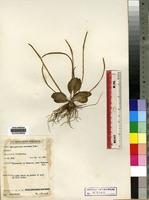
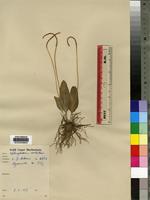
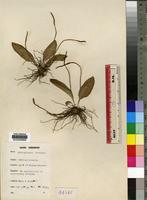
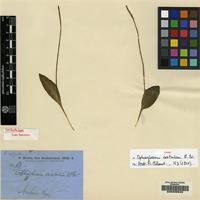
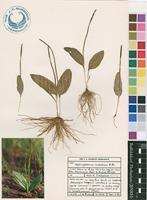
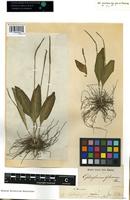
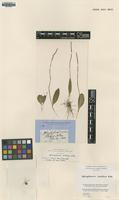
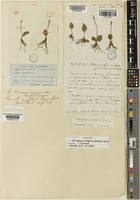
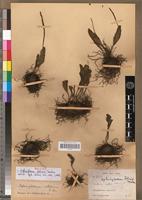
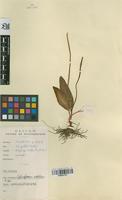
Perennial herb with deciduous aerial parts. Rhizome commonly globose, sometimes ellipsoid, (6–)9–12(–17) mm long, (4–)8–11(–16) mm wide; roots numerous, semi-fibrous, descending or radiating, not proliferous. Leaves 2 or 3, rarely single; stipe (8–)15–37(–65) mm long, 70–90% of its length subterranean, stipe:lamina ratio 0.4–0.7:1; stipe bases not persistent; lamina dull green, held at 60–80° from the ground, lanceolate to narrowly ovate, rarely ovate, usually flat, sometimes slightly folded or concave, (16–)29–58(–95) mm long, (8–)13–24(–31) mm wide, length:width ratio 2–3.1:1, apex acute to obtuse, usually shortly apiculate, base narrowly to broadly cuneate, margins flat; venation isodiametric distally and marginally, elongate medially and proximally, secondary and blind veins numerous laterally, pale median band prominent, epidermal cells elongate or isodiametric with wavy cell walls, stomata not aligned. Fertile spike (55–)140–175(–225) mm long, with (18–)33–40(–66) pairs of sporangia, fertile spike:lamina length ratio 2.6–3.2:1. Spores 34–39 µm in equatorial diameter, trilete, muri evenly reticulate, thinly capped with tapetal residue, lumina conical, pitted, granules lacking. Chromosome number: n = ± 116 (Sierra Leone), 120–124 (India). Fig. 3/3 (p. 9).