JSTOR Global Plants Home
  • Home
  • Browse
  • About
  • Access
  • Account
    • Saved Items
    • Profile
  • Log in

Global Plants

Skip to Main Content
  • JSTOR Global Plants Home
  • Global Plants

    • Browse
    • About
    • Access
    • Account
      • Saved Items
      • Profile
Log in
  • Browse
  • About
  • Access
  • Account
    • Saved Items
    • Profile
Advanced Search

Compilation
Ophiocaulon reticulatum

2 Images see all

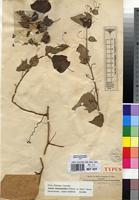
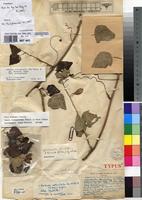
Type of Ophiocaulon reticulatum De Wild. & T.Durand [family PASSIFLORACEAE]
Previous
Next

Name

Identification
Ophiocaulon reticulatum De Wild. & T.Durand [family PASSIFLORACEAE ] Verified by Not on sheet, Adenia cissampeloides (Planch. & Hook.) Harms [family PASSIFLORACEAE ] (stored under name); Verified by Robyns A., 1989
Related name
  • Ophiocaulon reticulatum
  • Adenia cissampeloides

Flora

Entry for ADENIA reticulata (De Wild. & Th. Bur.) Engl. [family PASSIFLORACEAE]
Herbarium
Royal Botanic Gardens, Kew (K)
Collection
Flora of Tropical East Africa
Resource Type
Reference Sources
Entry From
Flora of Tropical East Africa, page 1, (1975) Author: W. J. J. O. de Wildem (Rijksherbarium, Leiden)
Names
ADENIA reticulata (De Wild. & Th. Bur.) Engl. [family PASSIFLORACEAE], V.E. 3(2) : 602 (1921); de Wilde in Acta Bot. Neerl. 17 : 129, 123, fig. 1/j (1968) & in C.F.A. 4 : 224 (1970) & in Meded. Landbouwhogeschool Wageningen 71–18 : 267 (1971). Type : Zaire, Mbandaka [Coquillatville], Dewèvre 691a (BR, holo. !)
Ophiocaulon reticulatum De Wild. & Th. Dur. [family PASSIFLORACEAE], in Compt. Rend. Soc. Bot. Belg. 38 : 86 (1899)
Adenia lobulata Engl. [family PASSIFLORACEAE], V.E. 3 (2) : 602 (1921); Harms in N.B.G.B. 8 : 293 (1923). Types : Zaire, Mukenge, Pogge 949 & Cameroon, Douala, Hückstädt 44 (both B, syn.†)
Information
Somewhat woody climber up to 15 m., up to 10 cm. thick at base, older stems ± triangular in cross-section; twigs grey-green, sometimes pruinose, spotted or not. Leaf-blades often variegated, very pale beneath, punctate or not, entire to 3–5-lobed or with sinuate margin, broadly ovate to ± triangular or rhombic, base cordate to rounded or truncate, top acute, up to 2 cm. acuminate, sometimes 1 mm. mucronate, 2–11 by 1.5–10 cm., 3–5-nerved from base and with (0–)1–2(–4) pairs of nerves from the midrib; nerves ascending or straight, ending in the leaf margin or not, reticulation distinct or not; margin entire; lobes subtriangular or rounded, up to 2 cm.; petiole 1–6.5 cm. Gland at blade-base single, on a median circular to spathulate appendage 1–2.5 mm.; blade-glands 0–30, small, scattered or submarginal, sometimes ± axillary to the nerves; marginal glands minute, blackish, 2–7 at either side of the blade. Stipules broad, rounded, finely lacerate, ± 0.5 mm. Inflorescences peduncled for 0.5–5 cm., up to 20-flowered in ♂, 2–3(–5)-flowered in ♀, tendril 0 or 1, 0.5–1.5 cm.; sterile tendrils simple or 3-fid, 10–20 cm. Male flowers ± campanulate, including the 1.5–4.5 mm. long stipe 7–14 mm.; hypanthium cup-shaped, 0.5–1(–2) by 3.5 mm.; calyx-tube 0(–1) mm.; sepals oblong-lanceolate, obtuse to subacute, subentire, 5–8 by 2–3 mm., punctate; petals oblanceolate, obtuse, with fimbriate margin, 5.5–8.5 mm., 3(–5)-nerved, sparingly punctate; filaments 1.5–2 mm., connate for 0.5–1 mm., inserted at the base of the hypanthium; anthers 3.5–4 mm., obtuse; septa (0.2–)0.5–1 mm. high; corona 0; disk glands 0. Female flowers ± campanulate, including the 0.2–1 mm. long stipe 6–7.5 mm.; hypanthium shallowly cup-shaped, 0.5–1 by 3–3.5 mm.; calyx-tube 0; sepals oblong to lanceolate, subacute, 4.5– 5.5 mm., subentire, punctate; petals lanceolate-linear, subobtuse to acute, 2.5–3 mm., 1-nerved, subentire, not punctate; staminodes ± 0.5 mm., connate for 0–0.3 mm.; septa 0–0.3 mm.; corona a low 5-lobed ring, ±0.3 mm. high; disk glands 0; gynophore ± 0.5 mm.; ovary ovoid, ± 3-ribbed, 3–4.5 mm., smooth or finely warty or granulate, style (0–)0.7 mm., stigmas sessile, reniform to globose, papillate, each 1–1.5 mm. in diameter. Fruits 1(–2) per inflorescence, subglobose, ovoid or ellipsoid, sometimes ± 3(–6)-angular, excluding the 0.5–1.5 mm. long gynophore 2–3(–3.5) by 1.5– 2(–2.5) cm.; pericarp coriaceous or woody, (0.5–)1–2 mm. thick, strongly warted to nearly smooth, or pitted. Seeds 30–50 per capsule, ovoid, 4– 4.5(–5) mm. Fig. 5/7, p. 21.
Range
DISTR. U4; T3, 4 W. and central Africa, from S. Nigeria to N. Angola
Altitude range
900–1200 m.
Distribution
TANZANIA Lushoto District Monga, Zimmermann in Herb. Amani 6581 !TANZANIA Kigoma District Kasakati, Aug. 1965, Suzuki 286 ! & 241 !UGANDA Masaka District NW. side of Lake Nabugabo, 9 Oct. 1953, Drummond & Hemsley 4713 !UGANDA Mengo District Kipayo, May 1914, Dummer 794 ! & Kajansi Forest, Apr. 1935, Chandler 1248 !
Notes
The East African specimens belong to the typical variety, as described above; in W. equatorial Africa var. cinerea de Wilde occurs also and is distinguished by a number of small characters.

Related Materials

  • Terms and Conditions
  • Privacy Policy
  • Cookie Policy
  • Cookie Settings
  • Accessibility
  • Help
  • Contact Us
  • Facebook
  • Twitter
ITHAKA

JSTOR is part of ITHAKA, a not-for-profit organization helping the academic community use digital technologies to preserve the scholarly record and to advance research and teaching in sustainable ways.

©2000-2026 ITHAKA. All Rights Reserved. JSTOR®, the JSTOR logo, JPASS®, Aluka®, and ITHAKA® are registered trademarks of ITHAKA.

╳