

Compilation
Oncoba sulcata
1 Images see all
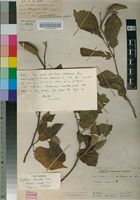
Name
Identification
Oncoba sulcata Sim [family SALICACEAE ] Verified by Not on sheet, Glyphaea tomentosa Mast. [family MALVACEAE ] (stored under name); Verified by Not on sheet,
Related name
- Oncoba sulcata
- Glyphaea tomentosa
Flora
Entry for Glyphaea tomentosa Mast. [family TILIACEAE]
Herbarium
Royal Botanic Gardens, Kew (K)
Collection
Flora Zambesiaca
Resource Type
Reference Sources
Entry From
FZ, Vol 2, Part 1, page 33, (1963) Author: H. Wild
Names
Glyphaea grewioides [family TILIACEAE], sensu Bak. f. in Journ. Linn. Soc., Bot. 40: 33 (1911).
Glyphaea tomentosa Mast. [family TILIACEAE], in Oliv., F.T.A. 1: 267 (1868). — Sim, For. Fl. Port. E. Afr.: 21 (1909). TAB. 2. Syntypes: Mozambique, Chupanga, Meller (K); Morrumbala, Waller (K).
Oncoba sulcata Sim [family TILIACEAE], tom. cit.: 12 (1909). Type: Mozambique, Maganja da Costa, Sim 5900 (PRE, holotype).
Information
Small tree up to 4 m. tall; young shoots shortly stellately tomentellous. Leaf-lamina 4–9 × 2–4 cm., oblong to obovate-oblong, acuminate or acute at the apex, with margin irregularly crenate-dentate, slightly cordate or rounded at the base, strongly 3-nerved and sometimes asymmetrical at the base, stellate-pubescent on both surfaces and with tufts of hairs in the axils of the nerves; petiole tomentellous, widening just below the leaf-blade; stipules c. 2 mm. long, very caducous, tomentellous, subulate. Inflorescence of leaf-opposed 1–3-flowered cymes towards the ends of the branches; peduncles up to 1 cm. long, tomentellous; pedicels similar, up to 1·7 cm. long, thickening considerably in fruit up to a diameter of c. 4 mm.; bracts c. 2 mm. long, subulate, tomentellous. Sepals up to 2·2 × 0·4 cm., narrowly oblong, rather blunt at the apex, tomentellous outside, glabrous and yellow inside, with margin slightly thickened. Petals golden-yellow, slightly shorter than the sepals, narrowly oblong, glabrous, blunt or 2-dentate at the apex. Stamens very numerous, about half the length of the sepals; anthers linear with two narrow parallel thecae, dehiscing by terminal pores, with the connective prolonged at the apex by a very short crest and with a pair of very short blunt horns prolonging the bases of the thecae. Ovary subsessile, villous, subcylindric, sulcate, with many ovules in each loculus; style glabrous, rather flattened, blunt at the apex; stigmatic surface not wider than the style, c. 5 mm. long. Fruit 4–7·5 × 2–3 cm., hard and woody, oblong-cylindric, blunt or very abruptly apiculate at the apex, abruptly truncate at the base, with 8–10 paired deeply incised ridges running longitudinally down the outside, smoothly stellate-tomentellous. Seeds numerous, c. 4 × 3 mm., discoid, brown, with a rather roughened testa.
Habitat
occurring in deciduous woodland.
Range
Apparently confined to Mozambique
Distribution
Mozambique MS Cheringoma, Inhaminga, fr. 25.v.1948, Mendonça 4385 (BM; LISC).Mozambique Z Morrumbala, fl., Waller (K).Mozambique N Nampula, fl. 1.i.1942, Mendonça 1198 (LISC; SRGH).
Notes
Closely related to G.brews (Spreng.) Monachino, the only other member of the genus, but differing in the following respects: G. brevis is a forest species, its fruiting pedicels remain slender and c. 2 mm. in diam. or less in fruit, the number of loculi in the ovary is usually fewer, the fruit is only sparsely stellate-pubescent and is usually gradually narrowed to both ends. The flowers of G.tomentosa are usually larger and the texture of the leaves thicker but in flowering material the separation of the two species is not so easy. No doubt this is a case where the area of distribution of one widespread species, under the influence of adverse conditions, probably in this case of decreasing rainfall, has contracted and left a relic population in Mozambique. Once cut off, this isolated population developed differences which now enable us to separate it at the specific level. It is in fact a borderline case and the differences from G. brevis would only have to be a little less definite before it would be best to consider G.tomentosa a subspecies.