

Compilation
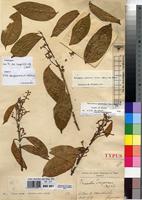
Oncinotis jespersenii
1 Images see all
Name
Identification
Oncinotis jespersenii De Wild. [family APOCYNACEAE ] Verified by Not on sheet, Oncinotis glabrata (Baill.) Stapf ex Hiern [family APOCYNACEAE ] (stored under name); Verified by de Kruif A.P.M., 1982
Related name
- Oncinotis jespersenii
- Oncinotis glabrata
Flora
Entry for ONCINOTIS glabrata (Baill.) Hiern [family APOCYNACEAE]
Herbarium
Royal Botanic Gardens, Kew (K)
Collection
Flora of Tropical East Africa
Resource Type
Reference Sources
Entry From
Flora of Tropical East Africa, page 1, (2002) Author: E.A. OMINO
Names
ONCINOTIS glabrata (Baill.) Hiern [family APOCYNACEAE], in Cat. Afr. Pl. Welwitsch 1(3): 674 (1898); Stapf in F.T.A. 4, 1: 222 (1902); Huber in F.W.T.A. ed. 2, 2: 80 (1963); de Kruif in Agric. Univ. Wageningen Papers 85 (2): 13, t. 1 (1985). Type: Angola, Cuanza Norte, Ambaca road, Welwitsch 5957 (P, holo., BM, COI, G, K, LISU, MO, iso.)
Motandra glabrata Baill. [family APOCYNACEAE], in Bull. Soc. Linn. Paris 1: 760 (1888)
Oncinotis jespersenii De Wild. [family APOCYNACEAE], Not. Pl. Util. Congo 2 (2): 256 (1908), as jesperseni . Type: Congo (Kinshasa), Equateur, near Mondombe, Jespersen 12 (BR, holo.)
Information
Climbing shrub or liana 1.2–40 m high; trunk 1.5–12 cm in diameter; bark greyish brown, with large pale brown lenticels; branchlets brownish green to grey, glabrous or rarely puberulous. Leaves petiolate; blade elliptic to ovate (to obovate), 3.9–13 cm long, 1.5–5 cm wide, acuminate (or rounded or emarginate) at the apex, cuneate at the base, glabrous (rarely puberulous on midrib and veins), glossy, dark to medium green above, with 5–12 pairs of secondary veins forming an angle of 50–75°, tertiary venation reticulate to faintly scalariform; domatia of pits, sometimes absent, sometimes with a ciliate margin; petiole 7–24 mm long, glabrous, rarely puberulous, with 1–3 clusters of 2–3 glands on the adaxial side. Inflorescence (2.5–)4–12.5 cm long, rusty brown-pubescent and glabrescent in all parts; bracts ovate to triangular, 1.2–1.7 mm long; pedicels 2–5 mm long. Flowers with sepals ovate, 1.5–3.6 mm long, rusty brown-pubescent; corolla yellow; tube urceolate, 2.5–4.7 mm long; lobes triangular, 2.3–5.8 mm long, 0.9–2.5 mm wide, glabrous or puberulous outside; corona later turning white, 0.5–0.9 mm long, pubescent at the base; pistil 2.9–3.5 mm long; style 0.1–0.2 mm long; ovules 60–120. Fruits fusiform, 9.8–30 cm long, 1.2–6.1 cm wide, exocarp 1–8 mm thick, very hard, longitudinally winged at maturity, wing undulate, 0.1–3 mm wide, puberulous to glabrescent; seeds numerous, 5–27×2–6.5 mm; coma 10–75 mm long.
Range
DISTR. U 4; T 4 tropical Africa from Guinea to Central African Republic and S from to Congo (Kinshasa), Burundi and Angola
Altitude range
1100–1800 m
Distribution
TANZANIA Mpanda District Kungwe, Mahali Peninsula, near head of Ntali R., 9 Sept. 1959, Harley 9569!UGANDA Mengo District 1.5 km NE of Entebbe town, below Katabi Hill, 18 Oct. 1950, Dawkins 659! & Kipayo Estate, May 1914, Dümmer 809! & near Mpoma in Kifu Forest, Apr. 1969, Lye et al. 2588
Notes
USES. None recorded