

Compilation
Oldenlandia rhodesiana
2 Images see all
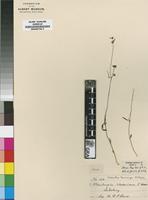
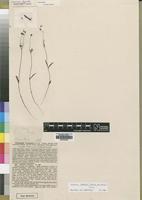
Name
Identification
Oldenlandia rhodesiana S.Moore [family RUBIACEAE ] Kohautia aspera (Roth) Bremek. [family RUBIACEAE ] (stored under name); Verified by Mantell,D.E.,
Related name
- Kohautia aspera
- Oldenlandia rhodesiana
Flora
Entry for Kohautia aspera Heyne ex Roth Bremek. [family RUBIACEAE]
Herbarium
Royal Botanic Gardens, Kew (K)
Collection
Flora Zambesiaca
Resource Type
Reference Sources
Entry From
FZ, Vol 5, Part 1, (1989) Author: B. Verdcourt
Names
Oldenlandia leclercii A. Chev. [family RUBIACEAE], in Bull. Mus. Hist. Nat. Paris, sér. 2, 5: 162 (1933). —Lebrun in Mitt. Bot. Staatss. München 10: 444 (1971) pro synon. Type from Mali.
Kohautia aspera Heyne ex Roth Bremek. [family RUBIACEAE], in Verh. K. Nederl. Akad. Wet., Afd. Natuurk., ser. 2, 48(2): 113 (1952). —Hepper, F.W.T.A., ed. 2, 2: 210 (1963). —Launert & Roessler in Merxm. Prodr. Fl. SW. Afr. 115: 16 (1966). —Lebrun in Mitt. Bot. Staatss. München 10: 444, Fig. 5 (1971). —Agnew, Upland Kenya Wild Flowers: 389 (1974). —Verdc. in F.T.E.A., Rubiaceae 1: 241 (1976). TAB.20, fig. I. Type from India.
Hedyotis aspera Heyne ex Roth [family RUBIACEAE], Nov. Pl. Sp.: 94 (1821). —Wight & Arn., Prodr. 1: 417 (1834). —Dalz. & Gibs., Bombay Fl.: 115 (1861). Type as for K. aspera.
Oldenlandia aspera Heyne ex Roth DC. [family RUBIACEAE], Prodr. 4: 428 (1830). —Hook. f., Fl. Brit. Ind. 3: 68 (1882) pro parte. —E.H.C. Krause in Engl., Bot. Jahrb. 14: 413 (1892). —Woodrow in Journ. Bomb. Nat. Hist. Soc. 11: 644 (1898) pro parte. —T. Cooke, Fl. Bombay 1: 591 (1903) pro parte. —Duthie, Fl. Gangetic Plain: 415 (1905) pro parte. —A. Chev. in Rev. Bot. Appl. 15: 892 (1935). Type as for K. aspera.
Hedyotis strumosa Hochst. ex A. Rich. [family RUBIACEAE], Tent. Fl. Abyss. 1: 364 (1847). —Walp., Ann. Bot. Syst. 2: 77 (1851). Type from the Sudan.
Oldenlandia strumosa Hochst. ex A. Rich. Hiern [family RUBIACEAE], F.T.A. 3: 58 (1877). —K. Schum. in Engl., Pflanzenw. Ost-Afr. C: 376 (1895). —Broun & Massey, Fl. Sudan: 258 (1929). —F.W. Andr., Fl. Pl. Anglo-Egypt. Sudan 2: 452, fig. 164 (1952). Type as for H. strumosa.
Oldenlandia rhodesiana S. Moore [family RUBIACEAE], in Journ. Bot. 40: 250 (1902). Type: Zimbabwe, Harare, fl. & fr. xii.1897, Rand 122 (BM holotype).
Oldenlandia cyanea Dinter [family RUBIACEAE], in Fedde, Repert. 19: 318 (1924). Type from Namibia.
Information
Erect unbranched to sparsely branched annual herbs 10–30 cm. tall; stems ± densely papillose often reddish at base and below nodes. Leaves (23)28–39(47) x (0.5)0.7–2.5(4) mm., linear, linear-lanceolate to narrowly elliptic-lanceolate, margins and midrib beneath papillose, otherwise surfaces scabrid to glabrous, apex acute, narrowed to the base; stipular sheath (0.7)1–1.6(2) mm. long, stipular lobes (0.5)0.7–1.2(2.5) mm. long. Inflorescences spike-like, many-flowered, mostly 2 subsessile flowers at a node, the flower in a fork of a dichasium distinctly pedicellate; peduncles 1–60 mm. long; pedicels (0)2–10(25) mm. long, all parts densely papillose like the stem. Calyx tube (0.6)1–1.4(1.5) x (0.5)0.7–1.5(1.7) mm. ovoid to elliptic, densely covered with rounded papillae; lobes (0.8)1–1.4(1.7) mm. long and (0.2)0.3–0.5(0.6) mm., narrowly triangular to linear-lanceolate, margins and midrib scabrid with stiff minute papillae. Corolla lobes above mostly white or blueish or pinkish white, bluish or mauve below, tube light green or greeny white, narrow part of tube outside with rounded minute papillae; tube slightly curved, altogether (2.1)2.3–3.1(3.4) mm. long, the dilated part ovoid-elliptic in shape, (0.8)1–1.3(1.5) x (0.4)0.5–0.8(0.9) mm., the narrow part (0.2)0.3–0.6(0.7) mm. wide; lobes (0.7)1–1.5(1.8) x (0.3)0.4–0.7(0.9) mm., ovate-triangular to ovate-oblong, not parted to the base, acute. Anthers ± oval, c. two thirds the length of the dilated tube; pollen 4–5-colporate. Style and stigma as long as the narrow part of the tube, stigma lobes 0.7–1(1.4) mm. long, tips touching the anthers. Capsules (2)2.2–3(3.4) x (2.8)3.4–4.3(4.7) mm., subglobose to globose, ± sparsely papillose. Seeds light brown, c. 0.4–0.5 mm. long, angular-subconic.
Habitat
In grassland, in open woodland and in disturbed areas, in cultivations and on roadsides; frequently in seasonally water-logged black clay (cotton) soils
Range
drier parts of tropical Africa and S. Africa
Altitude range
(400)700–2150 m.
2150
700
Distribution
Zimbabwe W Nyamandhlovu, Pasture Res. Station, fr. 10.i.1954, Plowes 1659 (SRGH).Zimbabwe N Lake Kariba, Dinosaur Island, 540 m., fl. & fr. i.1978, Kerfoot, Thomas, Schramm & Dyer 104 (J).
Distribution (external)
SW. Arabia
Pakistan
India