JSTOR Global Plants Home
  • Home
  • Browse
  • About
  • Access
  • Account
    • Saved Items
    • Profile
  • Log in

Global Plants

Skip to Main Content
  • JSTOR Global Plants Home
  • Global Plants

    • Browse
    • About
    • Access
    • Account
      • Saved Items
      • Profile
Log in
  • Browse
  • About
  • Access
  • Account
    • Saved Items
    • Profile
Advanced Search

Compilation
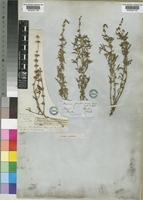
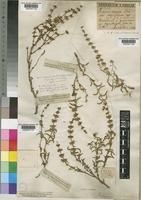
Ocimum fruticulosum

6 Images see all

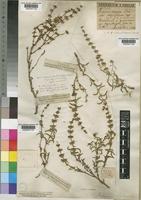
Ocimum americanum L. var. americanum [family LABIATAE]
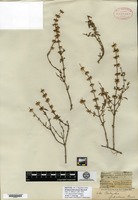
Isotype of Ocimum fruticulosum Burchell [family LAMIACEAE]
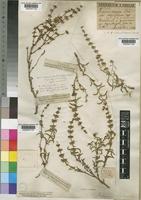
Ocimum americanum L. var. americanum [family LABIATAE]
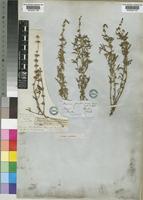
Type of Ocimum fruticulosum Burch. [family LABIATAE]
Previous
Next

Name

Identification
Ocimum americanum L. [family LABIATAE ] (stored under name); Ocimum fruticulosum Burch. [family LABIATAE ]
Related name
  • Ocimum canum
  • Ocimum fruticulosum
  • Ocimum americanum

Flora

Entry for OCIMUM fruticulosum Burchell [family LABIATAE]
Herbarium
Royal Botanic Gardens, Kew (K)
Collection
Flora Capensis
Resource Type
Reference Sources
Entry From
Flora Capensis, Vol 5, page 226, (1912) Author: By N. E. BROWN, T. COOKE and S. A. SKAN.
Names
OCIMUM fruticulosum Burchell [family LABIATAE], Trav. S. Afr. ii. 264;—Benth. in DC. Prodr. xii. 34.
OCIMUM canum Engl. var. integrifolium [family LABIATAE], Jahrb. x. 267.
Information
plant 8–12 in. high, branching from the woody base; branches obtusely 4-angled, pubescent to thinly and minutely puberulous with reflexed curved hairs; leaves shortly petiolate, 1/2–1 1/4 in. long, 2–3 1/2 lin. broad, linear-lanceolate, acute at both ends, entire or obscurely toothed, longitudinally folded (in dried specimens), glabrous on both sides with the exception of a few hairs along the midrib; racemes 2–4 1/2 in. long, sometimes arranged in a corymb-like panicle, with the whorls 1/3– 1/2 in. apart, about 6-flowered; lowermost bracts leaf-like, the remainder reflexed, petiolate, 1–2 lin. long, 1/2– 3/4 lin. broad, ovate or ovate-lanceolate, acute, cuneate at the base, glabrous, obscurely and minutely ciliate, persistent; pedicels 1–1 1/2 lin. long, thinly pubescent; calyx campanulate, pubescent and glandular outside, ciliate on the teeth, densely hairy within the tube, especially when in fruit; tube 1 (in fruit 1 1/2) lin. long; upper tooth 3/4 lin. long, orbicular, apiculate; lateral teeth 1/2 lin. long, deltoid, with a short subulate point; lower teeth 3/4 lin. long, subulate; corolla thinly pubescent outside; tube 1 1/3 lin. long; upper lip 1 1/3 lin. long, shortly 4-lobed; lobes subequal, obtusely rounded at the apex; lower lip 1 2/3 lin. long, 2/3 lin. broad, oblong, obtuse; stamens exserted much beyond the lower lip of the corolla, all free; upper pair inserted near the base of the corolla-tube, 1/4– 1/3 in. long, with a reflexed pubescent tooth near the base; lower pair inserted at the base of the lower lip, about 1/4 in. long, glabrous; nutlets 3/4 lin. long, ellipsoid, sometimes slightly angular at the sides, glabrous, black. null
Range
Also in Tropical German South-west Africa.
Distribution
KALAHARI REGION Griqualand West; on mountains near Klip Fontein, Burchell, 2160! 2634! Bechuanaland; Batlapin Territory, Holub! South African Gold Fields, Baines! Transvaal; near the Aapies River, Burke, 346!

Related Materials

  • Terms and Conditions
  • Privacy Policy
  • Cookie Policy
  • Cookie Settings
  • Accessibility
  • Help
  • Contact Us
  • Facebook
  • Twitter
ITHAKA

JSTOR is part of ITHAKA, a not-for-profit organization helping the academic community use digital technologies to preserve the scholarly record and to advance research and teaching in sustainable ways.

©2000-2026 ITHAKA. All Rights Reserved. JSTOR®, the JSTOR logo, JPASS®, Aluka®, and ITHAKA® are registered trademarks of ITHAKA.

╳