JSTOR Global Plants Home
  • Home
  • Browse
  • About
  • Access
  • Account
    • Saved Items
    • Profile
  • Log in

Global Plants

Skip to Main Content
  • JSTOR Global Plants Home
  • Global Plants

    • Browse
    • About
    • Access
    • Account
      • Saved Items
      • Profile
Log in
  • Browse
  • About
  • Access
  • Account
    • Saved Items
    • Profile
Advanced Search

Compilation
Ocimum citriodorum

5 Images see all

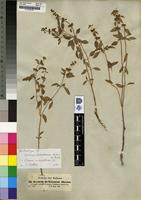
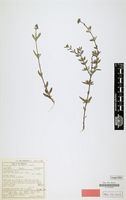
Neotype of Ocimum africanum Lour. [family LAMIACEAE]
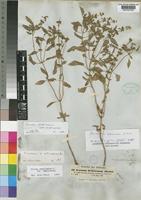
Ocimum citriodorum Vis. [family LAMIACEAE]
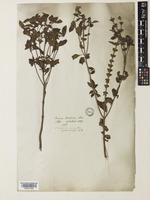
Isotype of Becium citriodorum S.D.Will.&K.Balkwill [family LABIATAE]
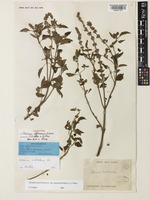
Isolectotype of Ocimum dichotomum Hochst. ex Benth. [family LAMIACEAE]
Ocimum americanum L. var. americanum [family LABIATAE]
Previous
Next

Name

Identification
Ocimum citriodorum Vis. [family LABIATAE ] Verified by Paton, A., Ocimum dichotomum Hochst. ex Benth. [family LABIATAE ] Ocimum americanum L. [family LABIATAE ] (stored under name); Verified by Paton, A., Ocimum canum Sims [family LABIATAE ] Verified by Ayobangira, Ocimum americanum L. [family LABIATAE ] Verified by Paton, A.,
Related name
  • Ocimum canum
  • Ocimum americanum
  • Ocimum dichotomum
  • Ocimum citriodorum

Flora

Entry for Ocimum citriodorum Vis. [family LABIATAE]
Herbarium
Royal Botanic Gardens, Kew (K)
Collection
Flora of Tropical Africa
Resource Type
Reference Sources
Entry From
Flora of Tropical Africa, Vol 5, page 332, (1900) Author: (by J. G. Baker)
Names
Ocimum citriodorum Vis. [family LABIATAE], Benth. in DC. Prod. xii. 39.
Information
Suffruticose. Stems pubescent. Leaves petioled, ovate-lanceolate, crenate-glabrous. Racemes lax, simple; whorls many-flowered; bracts acute, entire, shortly petioled, ciliate. Calyx villous outside and at the throat; upper lip orbicular; lateral teeth broadly ovate, apiculate; lower lanceolate subulate. Corolla violet-blue, longer than the calyx. Filaments of the upper stamens villous above the base.
Distribution
Nubia Nile Land cultivated in the botanic garden at Padua in 1840.

Related Materials

  • Terms and Conditions
  • Privacy Policy
  • Cookie Policy
  • Cookie Settings
  • Accessibility
  • Help
  • Contact Us
  • Facebook
  • Twitter
ITHAKA

JSTOR is part of ITHAKA, a not-for-profit organization helping the academic community use digital technologies to preserve the scholarly record and to advance research and teaching in sustainable ways.

©2000-2026 ITHAKA. All Rights Reserved. JSTOR®, the JSTOR logo, JPASS®, Aluka®, and ITHAKA® are registered trademarks of ITHAKA.

╳