JSTOR Global Plants Home
  • Home
  • Browse
  • About
  • Access
  • Account
    • Saved Items
    • Profile
  • Log in

Global Plants

Skip to Main Content
  • JSTOR Global Plants Home
  • Global Plants

    • Browse
    • About
    • Access
    • Account
      • Saved Items
      • Profile
Log in
  • Browse
  • About
  • Access
  • Account
    • Saved Items
    • Profile
Advanced Search

Compilation
Ochna stolzii

6 Images see all

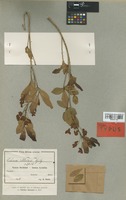
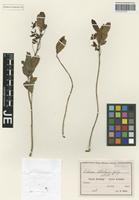
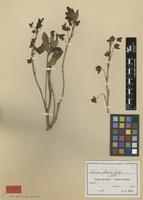
Isotype of Ochna stolzii Engl. [family OCHNACEAE]
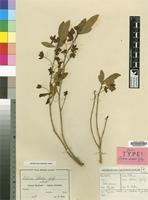
Type of Ochna stolzii Gilg ex Engl. [family OCHNACEAE]
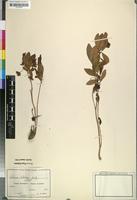
Isotype of Ochna stolzii Gilg [family OCHNACEAE]
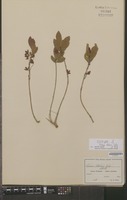
Isotype of Ochna stolzii Gilg ex Engl. [family OCHNACEAE]
Type of Ochna stolzii Gilg ex Engl. [family OCHNACEAE]
Previous
Next

Name

Identification
Isotype of Ochna stolzii Gilg ex Engl. [family OCHNACEAE ] (stored under name); Verified by orig.,
Related name
  • Ochna stolzii

Flora

Entry for Ochna stolzii Engl. [family OCHNACEAE]
Herbarium
Royal Botanic Gardens, Kew (K)
Collection
Flora of Tropical East Africa
Resource Type
Reference Sources
Entry From
Flora of Tropical East Africa, page 1, (2005) Author: B. Verdcourt, B.Sc., Ph.D.
Names
Ochna stolzii Engl. [family OCHNACEAE], V.E. 3 (2): 480 (1921) (in clav.); Gilg in E & P. Pf. ed. 2, 21: 68 (1925); Sleumer in N.B.G.B. 12: 69 (1934); Robson in F.Z. 2: 241 (1963). Type: Tanzania, Rungwe District: Kyimbila, Tandala, Stolz 2212 (B†, holo.)
Information
Shrub or small shrublet 0.35–2 m tall with smooth grey-brown bark and ascending reddish brown, puberulous branches, later greyish brown, glabrous and lenticellate. Leaves often drying metallic bluish green, somewhat coriaceous, small, elliptic to obovate, 1.2–5.5 cm long, 0.5–2.3 cm wide, acute to rounded at the apex, broadly cuneate to rounded at the base, margin spinulose-serrulate; lateral veins 13–15, ± prominent on both surfaces, the reticulate tertiary venation more obscure; petiole ± obsolete or up to 1.5 mm long; stipules linear, 4.5 mm long, deciduous. Flowers solitary or up to 3 in fascicles or rarely up to 7 in racemiform inflorescences with rhachis up to 8 mm long; pedicels 0.8–2.5 cm long, jointed near the base, glabrous or puberulous, often reflexed in fruit. Sepals oblong-elliptic, 6 mm long, 3–4 mm wide, becoming carmine red in fruit and 8–12 mm long, 5–6 mm wide. Petals yellow, obovate, 8–12 mm long, 3.5–8 mm wide. Anthers ± 1.5 mm long, slightly shorter than the filaments, dehiscing by longitudinal slits. Carpels 5; styles completely united; stigma subglobose. Drupelets black, elliptic, 7–8 mm long, 4–5 mm wide.
Range
DISTR. T 7
Altitude range
1800–1950(–2100) m
Distribution
TANZANIA Iringa District Mufindi, Lake Ngwazi, 28 Mar. 1991, Bidgood & Vollesen 2157!;TANZANIA Njombe District Njombe, 7 Dec. 1931, Lynes D81! & Njombe–Milo road, 28 Jan. 1961, Richards 14019!
Distribution (external)
N Malawi
Notes
The largest leaves I have seen are 4.3 cm long, 1.9 cm wide; the upper measurements are those of Sleumer. The highest altitude is that given by Stolz. Sleumer does not mention pubescence on the young branches and pedicels and some doubt must remain about Robson’s interpretation. Gereau & Kayombo 4021 (Tanzania, Njombe District: Livingstone Mts, Ligala Mt, 13 Feb. 1991, dense woodland at 2000 m) has leaves up to 4.5 x 2 cm and the pedicels and young branches are puberulous but the inflorescences have elongated axes and are arranged on closely placed nodules below the leaves forming a compound inflorescence ± 8 x 7 cm; the pedicel joint is 7 mm above the base and I have referred it to a small-leaved O. holstii. Sleumer does not give the length of the joint for O. stolzii. However, Robson has annotated some small-leaved specimens with basal joints as O. holstii. The true nature of these atypical southern O. holstii needs much further fieldwork.

Related Materials

  • Terms and Conditions
  • Privacy Policy
  • Cookie Policy
  • Cookie Settings
  • Accessibility
  • Help
  • Contact Us
  • Facebook
  • Twitter
ITHAKA

JSTOR is part of ITHAKA, a not-for-profit organization helping the academic community use digital technologies to preserve the scholarly record and to advance research and teaching in sustainable ways.

©2000-2026 ITHAKA. All Rights Reserved. JSTOR®, the JSTOR logo, JPASS®, Aluka®, and ITHAKA® are registered trademarks of ITHAKA.

╳