JSTOR Global Plants Home
  • Home
  • Browse
  • About
  • Access
  • Account
    • Saved Items
    • Profile
  • Log in

Global Plants

Skip to Main Content
  • JSTOR Global Plants Home
  • Global Plants

    • Browse
    • About
    • Access
    • Account
      • Saved Items
      • Profile
Log in
  • Browse
  • About
  • Access
  • Account
    • Saved Items
    • Profile
Advanced Search

Compilation
Ochna polyneura

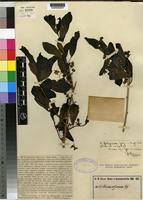
3 Images see all

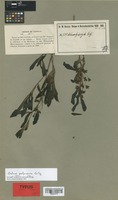
Syntype of Ochna polyneura Gilg [family OCHNACEAE]
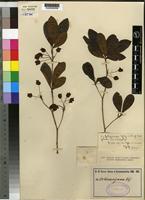
Isotype of Ochna hylophila Gilg [family OCHNACEAE]
Previous
Next

Name

Identification
Ochna polyneura Gilg [family OCHNACEAE ] (stored under name); Verified by Greenway PG, 1932
Related name
  • Ochna polyneura

Flora

Entry for Ochna polyneura Gilg [family OCHNACEAE]
Herbarium
Royal Botanic Gardens, Kew (K)
Collection
Flora of Tropical East Africa
Resource Type
Reference Sources
Entry From
Flora of Tropical East Africa, page 1, (2005) Author: B. Verdcourt, B.Sc., Ph.D.
Names
Ochna polyneura Gilg [family OCHNACEAE], in E.J. 33: 240 (1903); T.T.C.L.: 383 (1949); Robson in F.Z. 2: 242 (1963); Vollesen in Opera Bot. 59: 25 (1980). Types: Tanzania, (District not clear) Mbarangandu region, Busse 681 (B†, syn., EA!, isosyn., K, photo!)
Ochna hylophila Gilg [family OCHNACEAE], in E.J. 33: 242 (1903); T.T.C.L.: 383 (1949). Type: Tanzania, Songea District: Mampyui road on E Ungoni border, Busse 732 (B†, holo., EA!, iso., K, photo.!)
Information
Small tree, shrub or subshrub 0.3–6(–8) m tall with pale grey rough deeply fissured bark; branches reddish to purple-brown, mostly smooth, becoming whitish, with epidermis exfoliating, usually lenticellate, sometimes minutely papillose-puberulous. Leaves often bronze-tinged and sometimes drying quite dark bluish green, thin, obovate to oblanceolate or elliptic, (2.5–)3.5–10(–12) cm long, 1–3(–5) cm wide, narrowly rounded at the apex or subacute, cuneate to narrowly rounded at the base, margin densely usually rather shallowly serrulate; lateral veins ± 30, ± at right angles to midrib then more strongly curved upwards; tertiary venation closely reticulate, prominent above, much less so beneath; petiole 1–2 mm long. Buds large, ovoid, 15 mm long, 8 mm wide, acute, imbricate, the bracts strongly striate. Flowers (5–)6–10(–14) in elongated raceme-like inflorescences with rhachis 0.3–2.5(–3.5) cm long, rarely subumbellate; pedicels slender (1–)1.8–2.8(–3.5) cm long, papillose-puberulous or glabrous, jointed 1–7 mm from the base. Sepals pale green, oblong-elliptic, 5–7 mm long 1.5–2 mm wide, rounded at the apex becoming deep red in fruit and enlarging to 10–12(–15) mm long, 7 mm wide. Petals pale yellow, obovate to round, 9–13 mm long, 5–8 mm wide. Anthers 1–2 mm long, about 1/2 the length of the filaments, dehiscing by longitudinal slits. Carpels 5(–6–7); styles completely united; stigma subglobose. Drupelets black, ovoid or somewhat curved, (7–)8.5–10 mm long, 5–6 mm wide. Fig. 3 (p. 27).
Range
DISTR. T 6–8
Altitude range
(80–)130–1050(–2000) m
Distribution
TANZANIA Morogoro District near Kingolwira Station, 17 Nov. 1956, Welch 336!;TANZANIA Uzaramo District Lulenzi, 45 km WNW of Dar es Salaam, 3 Oct. 1977, Abdallah 208!;TANZANIA Songea District ± 12 km E of Songea, Nonganonga stream, 27 Dec. 1955, Milne-Redhead & Taylor 7915! & 21 Jan. 1956, 7915A!
Distribution (external)
Malawi
Zimbabwe
Mozambique

Related Materials

  • Terms and Conditions
  • Privacy Policy
  • Cookie Policy
  • Cookie Settings
  • Accessibility
  • Help
  • Contact Us
  • Facebook
  • Twitter
ITHAKA

JSTOR is part of ITHAKA, a not-for-profit organization helping the academic community use digital technologies to preserve the scholarly record and to advance research and teaching in sustainable ways.

©2000-2026 ITHAKA. All Rights Reserved. JSTOR®, the JSTOR logo, JPASS®, Aluka®, and ITHAKA® are registered trademarks of ITHAKA.

╳