

Compilation
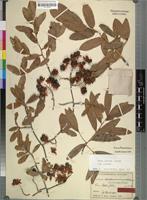
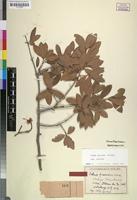
Ochna fuscescens
2 Images see all
Name
Identification
Ochna fuscescens Heine [family OCHNACEAE ] Verified by Not on sheet, Ochna pulchra Hook.f. [family OCHNACEAE ] (stored under name); Verified by Schreiber, A., 1966
Related name
- Ochna fuscescens
- Ochna pulchra
Flora
Entry for Ochna pulchra Hook. [family OCHNACEAE]
Herbarium
Royal Botanic Gardens, Kew (K)
Collection
Flora Zambesiaca
Resource Type
Reference Sources
Entry From
FZ, Vol 2, Part 1, page 224, (1963) Author: N. K. B. Robson
Names
Ochna pulchra Hook. [family OCHNACEAE], Ic. Pl. 6: t. 588 (“pulchrum ”) (1843). — Harv. in Harv. & Sond., F.C. 1: 449 (1860). — Oliv., F.T.A. 1: 317 (1868). — Gilg. in Engl., Bot. Jahrb. 33: 234 (1903). — Bak. f. in Journ. Linn. Soc., Bot. 40; 37 (1911). — Eyles in Trans. Roy. Soc. S. Afr. 5: 419 (1916). — Phillips in Bothalia, 1: 91 (1922). — Burtt Davy, F.P.F.T. 1: 238 (1926). — Burtt Davy & Hoyle, N.C.L.: 56 (1936). — Exell & Mendonça, C.F.A. 1, 2: 291, t. XIIB (1951). — Suesseng. in Proc. & Trans. Rhod. Sci. Ass. 43: 88 (1951). — O.B. Mill. in Journ. S. Afr. Bot. 18: 58 (1952). — Verdoorn in Fl. Pl. Afr. 29: t. 1139 (1952). — Pardy in Rhod. Agr. Journ. 49: 10, tt. (1952). — Palgrave, Trees of Central Afr.: 298, tt. (1956). — Story, Bot. Survey of S. Africa, Mem. 30: 35, photo. 33 (1958). — White, F.F.N.R.: 250, fig. 43C (1962). Type from the Transvaal.
Ochna rehmannii Szyszyl. [family OCHNACEAE], Polypet. Disc. Rehm.: 28 (1888). Type from the Transvaal.
Ochna aschersoniana Schinz [family OCHNACEAE], in Verh. Bot. Verein. Brand. 29: 61 (1888). — Gilg, tom. cit.: 235 (1903). Type from SW. Africa.
Ochna quangensis Büttn. [family OCHNACEAE], in Verh. Bot. Verein. Brand. 32: 49 (1890). — Gilg, tom. cit.: 235 (1903). — De Wild. in Rev. Zool. Afr., Suppl. Bot. 7: 38 (1919). Type from the Congo.
Polythecium pulchrum Hook. Van Tiegh. [family OCHNACEAE], in Ann. Sci. Nat., Ser. 8, Bot. 16: 368 (1902). Type as for Ochna pulchra.
Porochna huillensis Van Tiegh. [family OCHNACEAE], tom. cit.: 387 (1902). Type from Angola.
Porochna antunesii Van Tiegh. [family OCHNACEAE], loc. cit. Type from Angola.
Porochna brunnescens Van Tiegh. [family OCHNACEAE], tom. cit.: 388 (1902). Type from Angola.
Porochna davilliflora Van Tiegh. [family OCHNACEAE], loc. cit. Type from Angola.
Porochna bifolia Van Tiegh. [family OCHNACEAE], tom. cit.: 389 (1902). Type from “upper Zambezi”.
Ochna antunesii Engl. & Gilg [family OCHNACEAE], in Warb., Kunene-Samb.-Exped. Baum: 304 (1903). — Gilg, tom. cit.: 235 (1903). — R.E.Fr., Wiss. Ergebn. Schwed. Rhod.-Kongo Exped. 1: 150 (1914). — Eyles, loc. cit. Type as for Porochna antunesii.
Ochna brunnescens Engl. & Gilg [family OCHNACEAE], tom. cit.: 302 (1903). — Gilg, tom. cit.: 235 (1903). Type as for Porochna brunnescens.
Polythecium rehmannii Szyszyl. Van Tiegh. [family OCHNACEAE], op. cit. 18: 55 (1903). Type as for Ochna rehmannii.
Ochna pulchra forma integra Suesseng. [family OCHNACEAE], in Proc. & Trans. Rhod. Sci. Ass. 43: 88 (1951). Type: S. Rhodesia, Marandellas Distr., Dehn 474 (M, holotype; SRGH).
Ochna fuscescens Heine [family OCHNACEAE], in Mitt. Bot. Staatssamml. Münch. 1: 340 (1953). Type from SW. Africa.
Information
Shrub or small tree up to 8 (10·5) m. high, with bark smooth, grey to bluish-grey, flaking in thin sheets to reveal cream to yellow-brown or pale grey patches; branches slender or rather stout, spreading widely, creamy white at first, becoming dark grey. Leaves petiolate; lamina 3·5–18·5 × 1·3–5·7 cm., elliptic to oblong or oblanceolate (rarely obovate), acute or obtuse to rounded (often apiculate) at the apex, with margin entire or densely appressed-spinulose-serrulate towards the apex, narrowly cuneate or attenuate to rounded (rarely truncate to subcordate) at the base, subcoriaceous, with numerous (c. 20–30) lateral nerves and densely reticulate tertiary venation more prominent above than below; petiole 2–6 (8) mm. long, triangular in section or ± flattened, stout, often ± swollen; stipules oblanceolate or elliptic to subulate, 1–2 cm. long. Flowers (20) 25-c. 50, in a simple (rarely compound towards the base) terminal erect or pendulous raceme (1·5) 2·5–10·5 (15) cm. long in fruit; pedicels 1·2–2·7 cm. in fruit, articulated at the base or in the lower 1/3. Sepals 5–9 mm. long in flower, elliptic to obovate, rounded, becoming red or pink, 10–19 mm. long, convex and eventually reflexed in fruit. Petals golden to pale yellow, 9–11 (13) × 4–6·5 mm., obovate to oblanceolate. Stamens with anthers 1–2 mm. long, about 1/2 as long as the filaments, straight, dehiscing by apical pores. Carpels 7 (rarely 8), with styles free at the apex. Drupelets reniform, inserted centrally, 11–14 × 7–10 mm.: embryo curved.
Habitat
In open deciduous woodland or scrub, frequently on sand or rocky terrain
Range
From N. Rhodesia, Angola and the Congo south to SW. Africa, Bechuanaland Prot. and the Transvaal and east to western Mozambique
Altitude range
900–1700 m. in our area.
1700
900
Notes
O. pulchra is recorded from Nyasaland by Burtt Davy and Hoyle, Pardy and Palgrave, but I have seen no specimens from that region and these records may be based on misidentifications.O. pulchra is very variable in leaf-size and shape and several “species”have been split off from it. Only one of these variations appears to merit taxonomic recognition, on account of its correlation with an inflorescence character and its geographical distribution. Since the correlation is incomplete, however, it can most conveniently be treated as a subspecies.