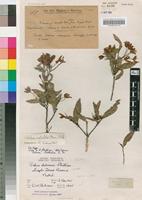
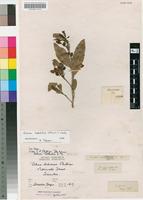
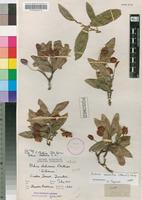
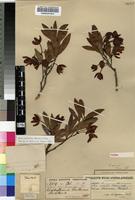
Bushy shrub or small tree 0.75–4·5 m. high (to 7 m. or more in Natal), sometimes branching below ground level, evergreen or deciduous, frequently galled, with bark rather rough, brown; branches ± ascending, whitish and flattened and frequently peeling at first, becoming purplish and terete with numerous lenticels (sometimes appearing lepidote). Leaves petiolate; lamina 3–12 (14·8) × 1–3·5 (5) cm., elliptic or oblong to oblanceolate (rarely obovate), rounded (more rarely obtuse to acute) and occasionally apiculate at the apex, with margin serrate with curved or straight teeth or almost entire, rounded or shallowly cordate (more rarely cuneate) at the base, coriaceous, with main and subsidiary lateral nerves almost equally prominent and tertiary venation prominent above but less so or almost plane below; petiole 1–2 mm. long, slender. Flowers (2) 3–14 (c. 20), in lax or ± condensed panicles or sometimes reduced to simple racemes or pseudumbels, terminal or on short axillary shoots; pedicels (0·8) 1·2–2·5 cm. long in fruit, articulated in the lower 1/4. Sepals 5–8 (11) mm. long in flower, elliptic to elliptic-oblong, rounded, becoming red, 7–12 (14) mm. long, ± convex and ± spreading in fruit. Petals bright yellow, sometimes dark-veined, (7) 8–18 (21) × 6–12 (14) mm., obovate or obovate-oblong to suborbicular and unguiculate. Stamens with anthers (1·75) 2–3 mm. long, 2/3–1 (1 1/3) times as long as the filaments, straight, dehiscing by apical pores. Carpels (6) 8–13, with styles united almost to the apex with free ends spreading radially or recurved; stigmas flattened. Drupelets subglobose or flattened-ovoid-cylindric, inserted near the base, 6–11 (12·5) × (4·5) 5–7 mm.; embryo straight.