JSTOR Global Plants Home
  • Home
  • Browse
  • About
  • Access
  • Account
    • Saved Items
    • Profile
  • Log in

Global Plants

Skip to Main Content
  • JSTOR Global Plants Home
  • Global Plants

    • Browse
    • About
    • Access
    • Account
      • Saved Items
      • Profile
Log in
  • Browse
  • About
  • Access
  • Account
    • Saved Items
    • Profile
Advanced Search

Compilation
Ochna beirensis

8 Images see all

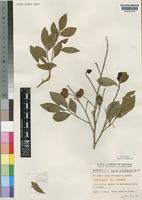
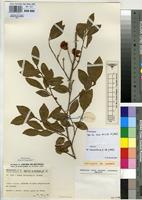
Isotype of Ochna beirensis N.Robson [family OCHNACEAE]
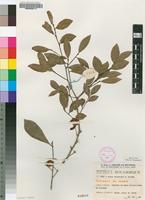
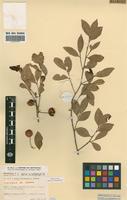
Holotype of Ochna beirensis N.Robson [family OCHNACEAE]
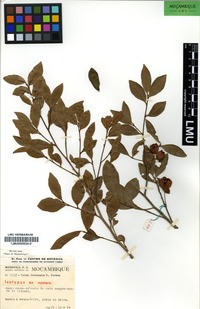
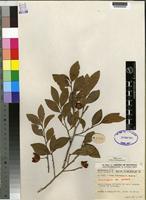
Isotype of Ochna beirensis N.Robson [family OCHNACEAE]
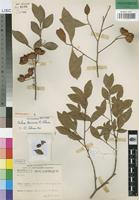
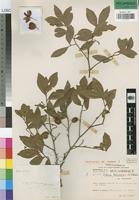
Isotype of Ochna beirensis Robson [family OCHNACEAE]
Isotype of Ochna beirensis N.Robson [family OCHNACEAE]
Previous
Next

Name

Identification
Isotype of Ochna beirensis N.Robson [family OCHNACEAE ] (stored under name); Verified by Not on sheet,
Related name
  • Ochna beirensis

Flora

Entry for Ochna beirensis N. Robson [family OCHNACEAE]
Herbarium
Royal Botanic Gardens, Kew (K)
Collection
Flora Zambesiaca
Resource Type
Reference Sources
Entry From
FZ, Vol 2, Part 1, page 224, (1963) Author: N. K. B. Robson
Names
Ochna beirensis N. Robson [family OCHNACEAE], in Bol. Soc. Brot., Sér. 2, 36: 17 (1962). Type: Mozambique, Beira, Praia da Beira, Mendonça 2507 (LISC).
Information
Shrub or small tree up to c. 5 m. high; branches terete or somewhat striate, reddish-brown at first, becoming pale brown or whitish, with numerous lenticels. Leaves petiolate; lamina 3·2–8·2 × 1·2–2·6 cm., rhombic-elliptic to oblong or oblanceolate, acute or shortly and bluntly acuminate at the apex, with margin sharply serrulate, narrowly cuneate to angustate at the base, subcoriaceous, with main and subsidiary lateral nerves equally prominent and the densely reticulate tertiary venation almost equally prominent on both sides; petiole 2–4 mm. long, slender. Flowers 3–5, in umbels terminating short axillary shoots; pedicels 2–2·5 cm. long in fruit, articulated 2–4 mm. from the base. Sepals becoming carmine-pink, 15–18 mm. long, convex and accrescent in fruit. Petals and stamens as yet unknown. Carpels 5. Drupelets flattened-ovoid-cylindric, inserted at the base, 11 × 7 mm.; embryo straight.
Habitat
Deciduous woodland and evergreen littoral scrub
Range
Known only from the Beira District of Mozambique.
Altitude range
near sea-level.
100
0
Distribution
Mozambique MS Cheringoma, Chinizíua, fr. 22.x.1949, Pedro & Pedrógão 8865 (LMJ; PRE).
Notes
O. beirensis is related to O. macrantha Bak. (Diporidium greveanum Van Tiegh.) from Madagascar, but differs in leaf-shape and venation.

Related Materials

  • Terms and Conditions
  • Privacy Policy
  • Cookie Policy
  • Cookie Settings
  • Accessibility
  • Help
  • Contact Us
  • Facebook
  • Twitter
ITHAKA

JSTOR is part of ITHAKA, a not-for-profit organization helping the academic community use digital technologies to preserve the scholarly record and to advance research and teaching in sustainable ways.

©2000-2026 ITHAKA. All Rights Reserved. JSTOR®, the JSTOR logo, JPASS®, Aluka®, and ITHAKA® are registered trademarks of ITHAKA.

╳