JSTOR Global Plants Home
  • Home
  • Browse
  • About
  • Access
  • Account
    • Saved Items
    • Profile
  • Log in

Global Plants

Skip to Main Content
  • JSTOR Global Plants Home
  • Global Plants

    • Browse
    • About
    • Access
    • Account
      • Saved Items
      • Profile
Log in
  • Browse
  • About
  • Access
  • Account
    • Saved Items
    • Profile
Advanced Search

Compilation
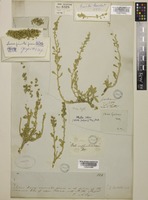
Obione gardneri

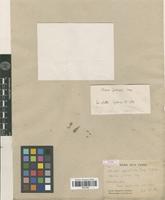
3 Images see all

Atriplex nuttallii S.Watson [family AMARANTHACEAE]
Holotype of Obione gardneri Moquin-Tandon [family CHENOPODIACEAE]
Type of Atriplex gardneri (Moq.) D.Dietr. [family AMARANTHACEAE]
Previous
Next

Name

Identification
Atriplex gardneri (Moq.) D.Dietr. [family AMARANTHACEAE ] (stored under name); Verified by Not on sheet, Obione gardneri Moq. [family AMARANTHACEAE ] Verified by Not on sheet,
Related name
  • Atriplex gardneri
  • Obione gardneri
Common name
  • Gardner’s saltbush, Flora of North America Vol. 4

Flora

Entry for Atriplex gardneri (Moquin-Tandon) D. Dietrich [family CHENOPODIACEAE]
Herbarium
Flora of North America (FNA)
Collection
Flora of North America
Resource Type
Reference Sources
Entry From
Flora of North America, Vol 4,
Names
Atriplex gardneri (Moquin-Tandon) D. Dietrich [family CHENOPODIACEAE], Syn. Pl., 5: 537. 1852
Obione gardneri Moquin-Tandon [family CHENOPODIACEAE], in A. P. de Candolle and A. L. P. P. de Candolle, Prodr., 13(2): 114. 1849
Atriplex nuttallii S. Watson subsp. gardneri (Moquin-Tandon) H. M. Hall & Clements [family CHENOPODIACEAE]
Atriplex nuttallii var. gardneri (Moquin-Tandon) R. J. Davis [family CHENOPODIACEAE]
Treatment Author(s)
Stanley L. Welsh
Information
Shrubs or subshrubs, dioecious or monoecious, 1–10 dm, unarmed. Stems prostrate to ascending, or less commonly erect. Leaves ± persistent, alternate or opposite to subopposite (especially proximally), sessile to petiolate; blade linear to oblanceolate, obovate, spatulate, or orbiculate, 5–55 × 2–25 mm, base cuneate, margin entire (rarely dentate), apex retuse to obtuse or rounded. Staminate flowers yellow or brown, in numerous clusters 2–4 mm wide, in spikes or panicles 2–30 cm. Pistillate flowers in spikes or panicles to 30 cm. Fruiting bracteoles 2–9 × 2–9 mm, bearing tubercles or wings or tubercles aligned in 4 rows or rarely smooth, apex toothed and usually with 2 or more lateral teeth. Seeds tan or brown, 1.5–2.5 mm wide.
Distribution
w North AmericaMexico.
Discussion
This is a widely distributed complex of intergrading genotypes of great phenotypic plasticity. The members occur commonly in fine-textured saline substrates in much of the western Great Plains and in the Intermountain Region. Diploids, triploids, tetraploids, and hexaploids (and higher polyploids, all multiples of the base number 9) are known within the complex, and hybrids are known not only between the constituents but with the other woody species which they contact, i.e., Atriplex canescens, A. confertifolia, and A. corrugata. Indeed, a case can be made for treating both A. gardneri and A. canescens within an expanded A. canescens. They are regarded here as forming two intergrading complexes, with some of the constituent varieties placed equally well within either of the species aggregations. The treatment essentially follows the alignment of taxa suggested by C. A. Hanson (1962), with the exception that they are reduced to varietal status and var. bonnevillensis and var. aptera are placed within the A. gardneri phase and not with A. canescens.

Related Materials

  • Terms and Conditions
  • Privacy Policy
  • Cookie Policy
  • Cookie Settings
  • Accessibility
  • Help
  • Contact Us
  • Facebook
  • Twitter
ITHAKA

JSTOR is part of ITHAKA, a not-for-profit organization helping the academic community use digital technologies to preserve the scholarly record and to advance research and teaching in sustainable ways.

©2000-2026 ITHAKA. All Rights Reserved. JSTOR®, the JSTOR logo, JPASS®, Aluka®, and ITHAKA® are registered trademarks of ITHAKA.

╳