JSTOR Global Plants Home
  • Home
  • Browse
  • About
  • Access
  • Account
    • Saved Items
    • Profile
  • Log in

Global Plants

Skip to Main Content
  • JSTOR Global Plants Home
  • Global Plants

    • Browse
    • About
    • Access
    • Account
      • Saved Items
      • Profile
Log in
  • Browse
  • About
  • Access
  • Account
    • Saved Items
    • Profile
Advanced Search

Compilation
Nymphaea flava

5 Images see all

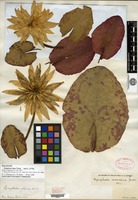
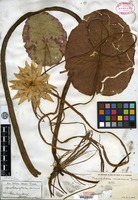
Holotype of Nymphaea lutea Treat [family NYMPHAEACEAE]
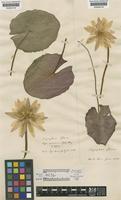
Type of Nymphaea flava Leitn. [family NYMPHAEACEAE]
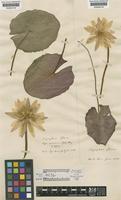
Nymphaea mexicana Zucc. [family NYMPHAEACEAE]
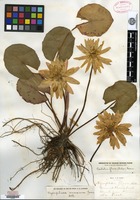
Filed as Nymphaea mexicana Zuccarini [family NYMPHAEACEAE]
Previous
Next

Name

Identification
Nymphaea flava Leitn. [family NYMPHAEACEAE ] Nymphaea mexicana Zucc. [family NYMPHAEACEAE ] (stored under name);
Related name
  • Nymphaea mexicana
  • Nymphaea flava
Common name
  • yellow water-lily, Flora of North America Vol. 3
  • herbe au coeur, Flora of North America Vol. 3
  • Banana water-lily, Flora of North America Vol. 3

Flora

Entry for Nymphaea mexicana Zuccarini [family NYMPHAEACEAE]
Herbarium
Flora of North America (FNA)
Collection
Flora of North America
Resource Type
Reference Sources
Entry From
Flora of North America, Vol 3,
Names
Nymphaea mexicana Zuccarini [family NYMPHAEACEAE], Abh. Math.-Phys. Cl. Königl. Bayer. Akad. Wiss., 1: 365. 1832
Castalia flava (Leitner) Greene [family NYMPHAEACEAE]
Nymphaea flava Leitner [family NYMPHAEACEAE]
Information
Rhizomes unbranched, erect, cylindric; stolons elongate, spongy, developing clusters of curved, fleshy, overwintering roots resembling tiny bananas at terminal nodes. Leaves: petiole glabrous. Leaf blade abaxially purplish with dark flecks, adaxially green, often with brown mottling, ovate to elliptic or nearly orbiculate, 7-18(-27) × 7-14(-18) cm, margins entire or sinuate; venation radiate and impressed centrally, without weblike pattern, principal veins 11-22; surfaces glabrous. Flowers floating or emersed, 6-11 cm diam., opening and closing diurnally, only sepals and outermost petals in distinct whorls of 4; sepals uniformly yellowish green, often red-tinted, evidently veined, lines of insertion on receptacle often slightly prominent; petals 12-30, yellow; stamens ca. 50-60, yellow, connective appendage minute or absent; filaments widest below middle, longer than anthers; pistil 7-10-locular, appendages at margin of stigmatic disk oblong-tapered, to 4.5 mm. Seeds globose, ca. 5 × 5 mm, uniformly covered with hairlike papillae 100-220 µm. 2n = 56.
Phenology
Flowering spring-fall, mainly summer farther north
Altitude range
0-1100 m
Distribution
nec Mexico.USA Ala.USA Ariz.USA Calif.USA Fla.USA Ga.USA La.USA Miss.USA N.C.USA Okla.USA S.C.USA Tex.
Discussion
Nymphaea mexicana is probably introduced in most inland sites and in California, where it is considered a problematic weed in waterways; it is not common in most states except Florida. The distribution of this species is similar to that of the winter distribution of canvasback ducks, for which the bananalike tubers are an important food (J. E. Cely 1979). This species forms natural hybrids with N. odorata; the hybrids have been named N. ×thiona D. B. Ward (D. B. Ward 1977). Except for stem characteristics, which resemble one or the other parent, and their added vigor, the hybrids are generally intermediate in morphology. They are completely sterile; however, hybrids with the stolon-bearing habit of N. mexicana can form extensive clones and, although somewhat larger in stature than N. mexicana, they closely resemble that less agressive parent and could easily be mistaken for it. Some of the introductions, such as in southeastern Nevada and north-central Kentucky, are clearly this hybrid.

Related Materials

  • Terms and Conditions
  • Privacy Policy
  • Cookie Policy
  • Cookie Settings
  • Accessibility
  • Help
  • Contact Us
  • Facebook
  • Twitter
ITHAKA

JSTOR is part of ITHAKA, a not-for-profit organization helping the academic community use digital technologies to preserve the scholarly record and to advance research and teaching in sustainable ways.

©2000-2026 ITHAKA. All Rights Reserved. JSTOR®, the JSTOR logo, JPASS®, Aluka®, and ITHAKA® are registered trademarks of ITHAKA.

╳