

Name
Identification
Nopalea cochenillifera (L.) Salm-Dyck [family CACTACEAE ]
Related name
- Nopalea cochenillifera
Common name
- cochineal nopal cactus, Flora of North America Vol. 4
- nopal a cochenille (N. cochenillifera (Linn.) Salm. Dyck.)., Burkill, H.M. 1985. The useful plants of west tropical Africa, Vol. 1
- tandaletando (FCD) (SIERRA LEONE, KISSI), Burkill, H.M. 1985. The useful plants of west tropical Africa, Vol. 1
- Nopal chamacuero, Flora of North America Vol. 4
- tunita, Flora of North America Vol. 4
- ngele-gonu (def.-goni) (FCD) (SIERRA LEONE, MENDE), Burkill, H.M. 1985. The useful plants of west tropical Africa, Vol. 1
Flora
Entry for Nopalea cochenillifera (Linnaeus) Salm-Dyck [family CACTACEAE]
Herbarium
Flora of North America (FNA)
Collection
Flora of North America
Resource Type
Reference Sources
Entry From
Flora of North America, Vol 4,
Names
Nopalea cochenillifera (Linnaeus) Salm-Dyck [family CACTACEAE], Cact. Hort. Dyck., 1849, 64. 1850
Cactus cochenilliferus Linnaeus [family ], Sp. Pl., 1: 468. 1753 (as cochenillifer)
Opuntia cochenillifera (Linnaeus) Miller [family CACTACEAE]
Past names
coccinellifera
Treatment Author(s)
Donald J. Pinkava
Information
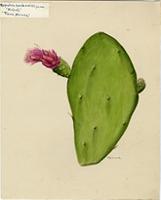
Shrubs or trees to 4–5 m; trunks 15–20 cm diam. Stem segments linear to narrowly obovate, some-times slightly falcate, (10–)15–35(–50) × 5–15 cm; areoles 2–3+ cm apart, 2–5 mm diam.; wool tawny, whitening with age. Spines usually absent or 1(–3), particularly on older pads, straight or curved, brown, aging gray, stout, to 2 cm. Glochids inconspicuous. Flowers 4–7 cm; inner tepals spatulate; crowded pink filaments and white style much longer than tepals, to 15 mm; nectar chamber elliptic to obconic. Fruits ellipsoid, 25–40 × 20–25 mm; areoles well distributed. Seeds tan to gray, 3–5 × 1.5–3 mm, slightly pubescent. 2n = 22 (Mexico, Puerto Rico as an escape).
Phenology
dec-feb (winter), mar (spring), sep-nov (fall)
Altitude range
0 m;
Distribution
MexicoWest Indies (Cuba)West Indies (Puerto Rico)Central America (Panama).USA Fla.
Discussion
The stem segments, or pads, of Nopalea cochenillifera are used as food, fodder, and poultices, and for rearing cochineal insects to obtain a red dye (once a major industry). This species may have been selected for spinelessness in Mexico, much like Opuntia ficus-indica, to ease the culturing and collection of cochineal scale insects for red dye.
Native/Introduced
introduced;