JSTOR Global Plants Home
  • Home
  • Browse
  • About
  • Access
  • Account
    • Saved Items
    • Profile
  • Log in

Global Plants

Skip to Main Content
  • JSTOR Global Plants Home
  • Global Plants

    • Browse
    • About
    • Access
    • Account
      • Saved Items
      • Profile
Log in
  • Browse
  • About
  • Access
  • Account
    • Saved Items
    • Profile
Advanced Search

Compilation
Nivenia reflexa

3 Images see all

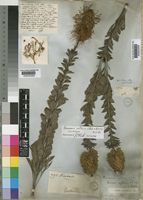
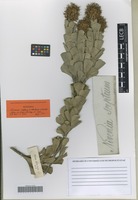
Lectotype of Paranomus reflexus (E.Phillips & Hutch.) Fourc. [family PROTEACEAE]
Syntype of Nivenia reflexa E. Phillips & Hutch. [family IRIDACEAE]
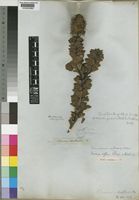
Paranomus reflexus (E.Phillips & Hutch.) Fourc. [family PROTEACEAE]
Previous
Next

Name

Identification
Nivenia reflexa E.Phillips & Hutch. [family PROTEACEAE ] Paranomus reflexus (E.Phillips & Hutch.) Fourc. [family PROTEACEAE ] (stored under name); Verified by Rourke, J.P., Nivenia sceptrum R.Br. [family PROTEACEAE ]
Related name
  • Leucospermum spathulatum
  • Nivenia reflexa
  • Nivenia sceptrum
  • Paranomus reflexus

Flora

Entry for NIVENIA reflexa Phillips & Hutchinson [family ]
Herbarium
Royal Botanic Gardens, Kew (K)
Collection
Flora Capensis
Resource Type
Reference Sources
Entry From
Flora Capensis, Vol 5, page 502, (1912) Author: By J. HUTCHINSON, E. P. PHILLIPS and O. STAPF.
Names
NIVENIA reflexa Phillips & Hutchinson [family ]
NIVENIA Sceptrum Meisn. [family ], in DC. Prodr. xiv. 299, as to Zeyher, 3713 β, and the following synonym.
Leucospermum spathulatum Drège ex Meisn. [family PROTEACEAE], l.c., not of R. Br.
Information
branches puberulous or tomentellous, rarely nearly glabrous; leaves dimorphic; the lower up to 3 1/2 in. long, bipinnately divided in the upper half, with the ultimate segments linear or rarely oblanceolate, obtuse, concave on the upper surface, glabrous; the upper erect, entire, 1–2 in. long, 1/2–1 in. broad, broadly obovate in the upper, gradually narrowed to the petiolar base in the lower half, coriaceous, glabrous on both surfaces, margins not or only very slightly cartilaginous; heads 4-flowered, spicate; spikes terminal, solitary, sessile or on a peduncle up to 1 1/2 in. long, 1 1/2–2 1/2 in. long, 1 1/4–1 1/2 in. in diam., subcylindric; flowering axis rusty-tomentose, bearing subulate-linear very acute glabrescent bracts about 4 lin. long; floral bracts 4, 1 3/4 lin. long, 1 1/3 lin. broad, ovate, obtuse, densely rusty-villous outside, glabrous within; flowers surrounded at the base by numerous long hairs; perianth-tube about 1 lin. long, nearly glabrous; segments 1 1/4 in. long, very slender; claws shortly pubescent or tomentellous; limb nearly 2 lin. long, linear, apiculate, shortly tomentose outside; anthers 1–1 1/2 lin. long, linear; hypogynous scales 2/3 lin. long, linear, acute; ovary with a ring of long hairs at the base, otherwise only very shortly pubescent; style very slender, 1 1/2 in. long, glabrous, gradually tapered into a very narrow cylindric obtuse stigma 3/4 lin. long and about 1/8 lin. thick; fruits 3 1/2 lin. long, ellipsoid, shortly beaked, glabrous. null
Distribution
COAST REGION Uitenhage Div.; Van Stadens Berg, Drège! Zeyher, 3713b! Van Stadens Berg, near Galgebosch, Burchell, 4686!

Related Materials

  • Terms and Conditions
  • Privacy Policy
  • Cookie Policy
  • Cookie Settings
  • Accessibility
  • Help
  • Contact Us
  • Facebook
  • Twitter
ITHAKA

JSTOR is part of ITHAKA, a not-for-profit organization helping the academic community use digital technologies to preserve the scholarly record and to advance research and teaching in sustainable ways.

©2000-2026 ITHAKA. All Rights Reserved. JSTOR®, the JSTOR logo, JPASS®, Aluka®, and ITHAKA® are registered trademarks of ITHAKA.

╳