JSTOR Global Plants Home
  • Home
  • Browse
  • About
  • Access
  • Account
    • Saved Items
    • Profile
  • Log in

Global Plants

Skip to Main Content
  • JSTOR Global Plants Home
  • Global Plants

    • Browse
    • About
    • Access
    • Account
      • Saved Items
      • Profile
Log in
  • Browse
  • About
  • Access
  • Account
    • Saved Items
    • Profile
Advanced Search

Compilation
Nephrodium pentheri

4 Images see all

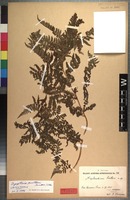
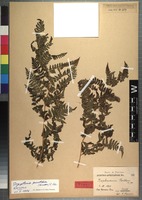
Lectotype of Dryopteris pentheri (Krasser) C. Chr. [family DRYOPTERIDACEAE]
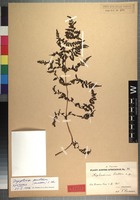
Isolectotype of Dryopteris pentheri (Krasser) C. Chr. [family DRYOPTERIDACEAE]
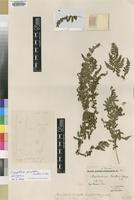
Syntype of Nephrodium pentheri Krasser [family DRYOPTERIDACEAE]
Previous
Next

Name

Identification
Nephrodium pentheri Krasser [family DRYOPTERIDACEAE ] Verified by Krasser,F., Dryopteris pentheri (Krasser) C.Chr. [family DRYOPTERIDACEAE ] (stored under name); Verified by Pichi-Sermolli,R.E.G.,
Related name
  • Nephrodium pentheri
  • Dryopteris pentheri

Flora

Entry for Dryopteris pentheri (Krasser) C.Chr. [family DRYOPTERIDACEAE]
Herbarium
Royal Botanic Gardens, Kew (K)
Collection
Flora of Tropical East Africa
Resource Type
Reference Sources
Entry From
Flora of Tropical East Africa, page 1, (2007) Author: J.P. Roux, Monika Shaffer-Fehre & Bernard Verdcourt
Names
Dryopteris pentheri (Krasser) C.Chr. [family DRYOPTERIDACEAE], Ind. filic . : 284 (1905); Faden in U.K.W.F. ed. 2: 36 (1994). Type: South Africa, Van Reenen’s Pass, 4 March 1895, Krook s.n., sub Penther Plantae Austro-Africanae 36 (W 8042!, lecto.; BM!, isolecto.) designated by Pichi Sermolli (166: 1985)
Nephrodium pentheri Krasser [family DRYOPTERIDACEAE], in Ann. K. K. Nat. Hofmus. 15: 5 (1900)
Dryopteris inaequalis [family DRYOPTERIDACEAE], [sensu Schelpe, F.Z., Pterid.: 221 (1970), non (Schltdl.) Kuntze].
Information
Terrestrial or epilithic; rhizomeshort-decumbent, sparsely branched, up to 20 mm in diameter, with closely spaced stipe bases and with stramineous to ferrugineous linear, oblong or narrowly ovate scales to 37≈6 mm, with long twisted filiform outgrowths. Fronds tufted, erect to arching, up to 1.8 m long; stipeproximally castaneous, brown to stramineous higher up, up to 49 cm long and 10 mm in diameter, near base with dense stramineous to ferrugineous narrowly lanceolate to filiform scales up to 40≈7 mm, with long twisted filiform outgrowths and often also with scattered glands, scales higher up fugaceous; lamina herbaceous, ovate to ovate-triangular, up to 78 cm long, 2-pinnate to 3-pinnate; rachis stramineous, becoming narrowly winged towards apex, with fugaceous narrowly lanceolate to linear scales up to 7≈2 mm; pinnae in up to 16 stalked pairs, basal pinna pair inaequilaterally ovate to oblong-acuminate towards lamina apex, basal pair longest, mostly basiscopically developed, up to 315≈185 mm, with up to 9 stalked pinnule pairs; pinna-rachisnarrowly winged distally, abaxially with scales up to 5 mm≈1.6 mm and hairs of three types (unicellular, bicellular and pluricellular simple or branched); pinnuleslanceolate to oblong-acuminate, basiscopically decurrent, acroscopic pinnule on basal pinnae up to 90≈35 mm, basiscopic pinnule on basal pinnae up to 112≈42 mm; segments ovate to oblong-obtuse, basiscopically decurrent, up to 22≈9 mm, lobed, lobes serrate, adaxially glabrous, with oblong glands along and between veins, or with a few hairs along costule, abaxially sparsely set with glands and hairs mostly along costule and veins. Sorimedial on predominantly anadromous vein branches, discrete, circular, up to 1.8 mm in diameter at maturity, essentially uniseriate; sporangiumstalk simple, or with one or more glandular cells, but mostly with a long multicellular, uniseriate hair; indusium persistent, pale brown, firmly herbaceous, reniform, entire, repand, or erose, (rarely glandular along margin), often strongly revolute, up to 1.8 mm in diameter. Spores with perispore folded into tubercles or reticulate ridges, finely rugose to ruminate, 38–60≈27–40 mm.
Range
DISTR. U 2; K 3–5, 7; T 2–4, 6–8
Altitude range
(700–)900–2700(–2900) m
Distribution
KENYA Trans-Nzoia District Cherangani, Kapolet, Aug. 1963, Tweedie 2681!KENYA Machakos District Mt Nzaui, 16 Feb. 1969, Faden & Evans 69/191!KENYA Teita District Taita Hills, road from Weruga to Mgange, 19 Nov. 1969, Bally et al. 2972!TANZANIA Mbulu District Mt Hanang, below Werther’s Peak, 12 Feb. 1946, Greenway 7726!TANZANIA Buha District Kasakela Reserve, 20 Nov. 1962, Verdcourt 3387!TANZANIA Lindi District Rondo Forest Reserve, 10 Feb. 1991, Bidgood et al. 1456!UGANDA Ruwenzori, Mihunga, no date, Loveridge 358!UGANDA Ankole District Buhweju, Nyagoma-Rugongo, 9 Feb. 1990, Rwaburindore 2949!UGANDA Kigezi District Kigezi, Kirata gap, Chandler & Hancock 2532!
Distribution (external)
Guinea-Bissau
Bioko
Cameroon
Burundi
Sudan
Ethiopia
Zambia
Malawi
Mozambique
Zimbabwe
Swaziland
Lesotho
South Africa
Madagascar
Notes
USES. None recorded for our area. CONSERVATION Widespread; least concern (LC). Vida, in Helv. Chim. Acta 56: 2129 (1973), under D. inaequalis, reports the species as tetraploid: 2 n = 164 ±4 and 2n = ± 164.

Related Materials

  • Terms and Conditions
  • Privacy Policy
  • Cookie Policy
  • Cookie Settings
  • Accessibility
  • Help
  • Contact Us
  • Facebook
  • Twitter
ITHAKA

JSTOR is part of ITHAKA, a not-for-profit organization helping the academic community use digital technologies to preserve the scholarly record and to advance research and teaching in sustainable ways.

©2000-2026 ITHAKA. All Rights Reserved. JSTOR®, the JSTOR logo, JPASS®, Aluka®, and ITHAKA® are registered trademarks of ITHAKA.

╳