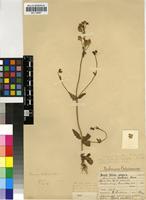
an erect herb, annual, about 1 ft. high, glabrous below, glandular-pilose above, sparingly branched; stem leafy at the base, obtusely quadrangular below, somewhat flexuous, shining, towards the apex tetragonous, wiry; branches rather slender, patent, or ascending, internodes mostly exceeding the leaves; leaves opposite or subopposite, ovate, oval or lanceolate or the basal obovate, obtuse or subacute at the apex, obtuse or more or less narrowed at the base, sessile or subsessile or the basal tapering downwards, more or less strongly toothed except the denticulate basal ones, 3/8–1 1/4 in. long, 1/8– 1/2 in. broad, subglabrous, minutely glandular-papillose; flowers about 1/3 in. long; racemes terminal, minutely pilose, rather dense, 2 1/2 in. long in fruit, shorter in flower, several- or many-flowered, corymbose or oval; bracts alternate, lanceolate, entire or with few teeth, sessile, 1/6– 3/8 in. long; pedicels 1/3– 3/4 in. long; calyx-segments linear-oval or -oblong, obtuse, glandular-pilose, 1/6– 1/3 in. long; corolla pallid, about 1/3 in. broad, saccate at the base; lips about 1/6 in. long; upper lobes ovate-oblong, about 1/12 in. long; lower lip rounded, about 1/6 in. broad; palate bearded; pouch about 1/12 in. broad and deep, rounded; capsule obliquely ovoid, broadly notched at the apex, a little contracted near the apex, unequally narrowed towards the base, not horned, 1/3– 1/2 in. long, 1/4– 3/10 in. broad. null