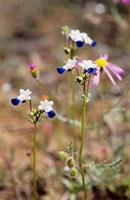
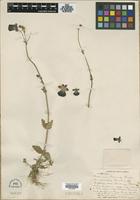
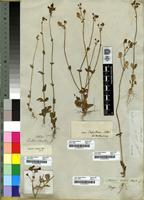
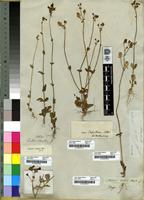
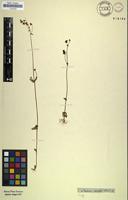
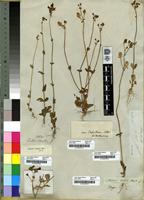
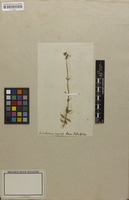
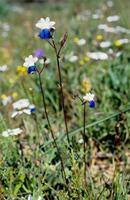
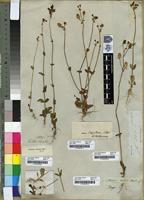
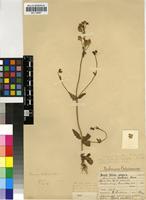
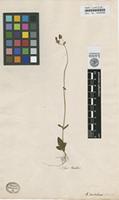
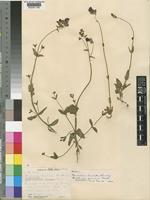
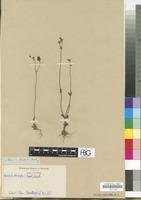
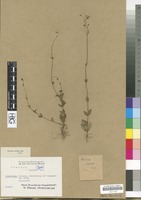
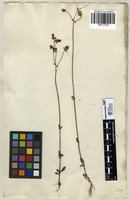
an erect or ascending herb, annual, nearly glabrous, shining, 5–20 in. high, branched from the base or simple, somewhat slender; stem and branches leafy below, quadrangular, angles slightly scabrid or smooth; leaves opposite, ovate or oval or the upper lanceolate, obtuse at the apex, subtruncate or very obtuse at the sessile or subsessile amplexicaul base, or in the case of the lower leaves shortly petiolate, coarsely dentate or the lower nearly entire, 1/3–1 1/4 in. long, 1/8– 3/4 in. broad; racemes terminal, pilose, 2–9-flowered, 1–4 in. long, corymbose or oblong; bracts alternate, smaller than the leaves; pedicels in the axils of the bracts, ranging up to 1 1/4 lin. long; calyx-segments linear or narrowly oval, obtuse, hispid-pilose, 1/8– 1/4 in. long; corolla 3/8– 2/3 in. long; the upper lip 4-lobed, 1/6– 1/4 in. long, white outside, inside blue above with a white margin and purple-striate below; lobes semi-elliptical, 1/8– 1/6 in. long, 1/11– 1/10 in. broad, rounded at the apex; lower lip broadly oblong, widened towards the rounded entire or emarginate apex, keeled on the upper half, blue, 1/3– 1/2 in. long; lower part or claw white, striped with red outside, geniculate and strongly bearded inside, 1/6– 1/3 in. broad; spur conical, straight, 1/8– 1/6 in. long, 1/6– 3/16 in. broad, obtuse, striped with purple lines, looking as if made up of the combination of two horns; capsule urceolate or ovoid-oblong, 1/3– 1/2 in. long, 1/6– 1/4 in. broad, apices of the valves forming an obtuse angle with diverging apiculi. null