

Compilation
Nelsonia smithii
1 Images see all
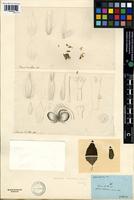
Name
Identification
Nelsonia smithii rsted [family ACANTHACEAE ] (stored under name); Verified by Not on Sheet, Nelsonia canescens (Lam.) Spreng. [family ACANTHACEAE ] Verified by Not on Sheet, Nelsonia densiflora rd (=rsted) [family ACANTHACEAE ] Verified by Not on Sheet,
Related name
- Nelsonia smithii
- Nelsonia densiflora
- Nelsonia canescens
Common name
- asresidie (FRI) (GHANA, AKAN-ASANTE), Burkill, H.M. 1985. The useful plants of west tropical Africa, Vol. 1
Flora
Entry for Nelsonia smithii Oerst. [family ACANTHACEAE]
Herbarium
Royal Botanic Gardens, Kew (K)
Collection
Flora of Tropical East Africa
Resource Type
Reference Sources
Entry From
Flora of Tropical East Africa, page 1, (2008) Author: Kaj Vollesen
Names
Nelsonia smithii Oerst. [family ACANTHACEAE], in Vidensk. Medd. Naturhist. Foren. Kjöb. 1854: 119 (1854); Morton in K.B. 33: 401 (1979); Vollesen in Proc. XIIIth Plen. Meet. AETFAT 1: 322 (1994); Friis & Vollesen in Biol. Skr. 51(2): 451 (2005); Ensermu in F.E.E. 5: 347 (2006). Type: “Congo”, Smith s.n. (C!, holo.; BM!, iso.)
Nelsonia canescens (Oerst.) E. Hossain var. smithii [family ACANTHACEAE], in Willdenowia 14: 403 (1984); Lebrun & Stork, Enum. Pl. Afr. Trop. 4: 496 (1997)
Information
Perennial herb without central rootstock; stems usually trailing and ascending apically, but sometimes semi-erect when growing in dense vegetation, rooting at lower nodes, up to 50 cm long, puberulous to pubescent or sparsely so with thick (flat and collapsed when dry) many-celled curly hairs, sometimes with long thin pilose hairs intermixed on uppermost node. Leaves with petiole 0.5–3 cm long; lamina ovate to elliptic, below middle abruptly narrowed into an attenuate to cuneate or rounded base, largest 3.5–8.7≈1.8–4 cm, apex subacute to rounded; beneath subglabrous or with sparse to dense ± appressed thick hairs on veins, glabrous or with sparser hairs on lamina, above subglabrous or with scattered thick many-celled hairs. Spikes 1–4.5(–7) cm long, axis pilose; peduncle 2–5 mm long, densely pilose with long thin hairs and with long-stalked capitate glands; bracts elliptic or broadly so, 5–9≈3–5.5 mm, narrowing gradually or concave (with distinct “shoulders”) below the acute tip, puberulous and with few to many long pilose hairs and with usually dense long-stalked capitate glands; pedicel ± 0.5 mm long, with dense long pilose hairs. Sepals ± equal in length, 3.5–5.5 mm long, acute; dorsal elliptic; ventral narrowly elliptic and divided 1/4–1/3 down; lateral lanceolate; all with long pilose hairs (up to 3 mm long) all over or at base only and with stalked capitate glands towards apex. Corolla pink to mauve (rarely white or white with a pink tinge), subactinomorphic, ± hairy in throat; tube 2.5–4 mm long, narrowing slightly upwards and then widened into a short ventral pouch; lobes ± spreading, 2–3 mm long, slightly emarginate to rounded. Stamens held in the pouch, subsessile; anthers ± 0.5 mm long, thecae parallel, basal flanges absent or minute. Capsule 3.5–5 mm long, glabrous. Seeds numerous (usually over 20), ± 0.5 mm long.
Range
DISTR. U 2–4; T 1, 3, 4, 7 widespread in the forest regions of Africa from Guinea to SW Ethiopia and south to N Malawi, N Zambia and Angola
Altitude range
700–1300(–1500) m
Distribution
TANZANIA Lushoto District E Usambara Mts, Kwamkoro to Amani, 15 Dec. 1916, Peter 60482!TANZANIA Mpanda District Mt Kungwe, Kasoje, 16 July 1959, Newbould & Harley 4384!TANZANIA Rungwe District Kyimbila, 12 Oct. 1910, Stolz 334!UGANDA Kigezi District Ruhinda, May 1946, Purseglove 2048!UGANDA Busoga District Butembe Bunya, 15 km E of Jinja, Linya Valley Forest, 4 Dec. 1952, G.H.S. Wood 549!UGANDA Mengo District near Sisa, Sep. 1937, Chandler 1927!
Notes
Until Morton (l.c.) resurrectedN. smithiiit had long been general practice to treat all African material as one very variable species. Even though some of the separating characters used by Morton break down others can be found, and I agree with him that there are two distinct species over most of Africa. One (N. smithii) is a wet forest species and the other (N. canescens) is a dry bushland species. The latter has obviously benefited from man’s presence and has in recent times become more widely dispersed as a result of human activity.