JSTOR Global Plants Home
  • Home
  • Browse
  • About
  • Access
  • Account
    • Saved Items
    • Profile
  • Log in

Global Plants

Skip to Main Content
  • JSTOR Global Plants Home
  • Global Plants

    • Browse
    • About
    • Access
    • Account
      • Saved Items
      • Profile
Log in
  • Browse
  • About
  • Access
  • Account
    • Saved Items
    • Profile
Advanced Search

Compilation
Nabea montana

10 Images see all

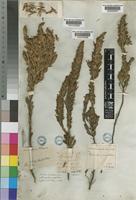
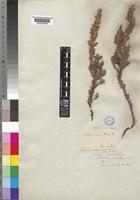
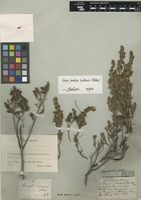
Nabea montana Lehm. [family ERICACEAE]
Isosyntype of Erica nabea Guthrie & Bolus [family ERICACEAE]
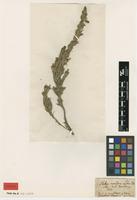
Nabea montana Lehm. Kl. [family ERICACEAE]
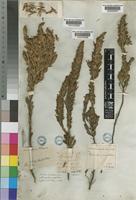
Nabea montana Lehm. [family ERICACEAE]
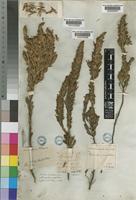
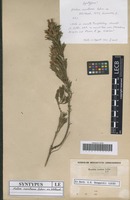
Syntype of Nabea montana Lehm. ex Klotzsch [family ERICACEAE]
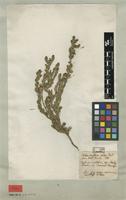
Nabea montana Lehm. [family ERICACEAE]
Syntype of Nabea montana Lehm. ex Klotzsch [family ERICACEAE]
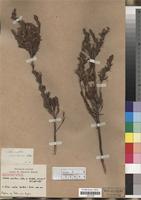
Filed as Erica nabea Guthrie & Bolus [family ERICACEAE]
Syntype of Nabea montana Lehm. ex Klotzsch [family ERICACEAE]
Previous
Next

Name

Identification
Erica nabea Guthrie & Bolus [family ERICACEAE ] (stored under name); Verified by HBG-formal name change, 2010 Macnabia montana (Lehm. ex Klotzsch) Benth. [family ERICACEAE ] Verified by Not on sheet, Nabea montana Lehm. ex Klotzsch [family ERICACEAE ] Verified by HBG-formal name entry, 2010
Related name
  • Erica nabea
  • Nabea montana
  • Macnabia montana
  • Erica mirabilis

Flora

Entry for ERICA Nabea Guthrie & Bolus [family ERICACEAE]
Herbarium
Royal Botanic Gardens, Kew (K)
Collection
Flora Capensis
Resource Type
Reference Sources
Entry From
Flora Capensis, Vol 4, page 2, (1909) Author: By H. BOLUS, F. GUTHRIE, and N. E. BROWN.
Names
ERICA Nabea Guthrie & Bolus [family ERICACEAE]
Nabea montana Lehm. [family ], Ind. Sem. Hort. Hamb. 1831, 5, name only; Klotzsch in Linnæa, viii. 667.
Macnabia montana Benth. [family ], in DC. Prodr. vii. 612.
Information
erect, 3–5 ft. high; branches virgate, the younger villous, glabrescent, the older with many short lateral, floriferous branchlets; leaves 3-nate, erect-spreading, linear-subulate, acuminate, sulcate, ciliolate, 5–7 lin. long; inflorescence terminal, flowers 1–2 on the short branchlets, mostly in long dense leafy pseudo-racemes, or more rarely somewhat lax and interrupted on longer branchlets, suberect to spreading, subsessile, calycine; bracts closely approximate, ovate to lanceolate, like the sepals glumaceous, 3–4 lin. long; sepals in opposite pairs, the outer pair lanceolate, acute or acuminate, the inner pair more oblong and more obtuse, concave, 7–8 lin. long, much exceeding the corolla; corolla subovate, 4-fid (or at length, being ruptured by the swelling ovary, 4-partite), 1 1/3–1 1/2 lin. long; segments erect, ovate, obtuse, about as long as the tube; stamens 5–6 lin. long, shorter than the sepals, much exceeding the corolla; anthers terminal, longitudinally semilanceolate, acute, smooth, submembranous; cells deeply partite, about 3/4 lin. long; pore nearly as long as the cell; style subexserted, hooked; stigma capitate; ovary glabrous; seeds broadly margined. null
Distribution
COAST REGION George Div.; Montagu Pass, 3500 ft., Schlechter, 5820! Devils Kop, near George, Mund, ex Klotzsch. Uniondale Div.; mountains between Avontuur and Vlugt, Bolus, 2381! Uitenhage Div.; Van Stadens Berg, Zeyher, 3308!
Notes
There seems no sufficient reason for retaining the genus Nabea. It has no characters which are not found in a greater or lesser degree in several species of Erica; and the only one for which it is remarkable is the great length of the sepals compared with the corolla. But the range of variation in the relative size and length of these organs in the genus (as generally admitted) is very great, and it does not seem well to uphold the separation on that ground. The much compressed and wide-margined seeds connect the species with the § Platyspora, but from that it is separated both by its calycine flowers, and the very different shape of its corolla. In some respects it approaches to the § Eurystegia. The name E. montana, having been pre-occupied, it is necessary to give the plant a new specific name, and it seems better to revert to the generic name of Lehmann.

Related Materials

  • Terms and Conditions
  • Privacy Policy
  • Cookie Policy
  • Cookie Settings
  • Accessibility
  • Help
  • Contact Us
  • Facebook
  • Twitter
ITHAKA

JSTOR is part of ITHAKA, a not-for-profit organization helping the academic community use digital technologies to preserve the scholarly record and to advance research and teaching in sustainable ways.

©2000-2026 ITHAKA. All Rights Reserved. JSTOR®, the JSTOR logo, JPASS®, Aluka®, and ITHAKA® are registered trademarks of ITHAKA.

╳