JSTOR Global Plants Home
  • Home
  • Browse
  • About
  • Access
  • Account
    • Saved Items
    • Profile
  • Log in

Global Plants

Skip to Main Content
  • JSTOR Global Plants Home
  • Global Plants

    • Browse
    • About
    • Access
    • Account
      • Saved Items
      • Profile
Log in
  • Browse
  • About
  • Access
  • Account
    • Saved Items
    • Profile
Advanced Search

Compilation
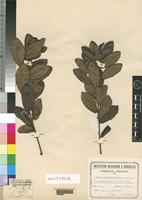
Myrica arborea

1 Images see all

Holotype of Myrica arborea Hutch. var. kenyensis Chiov. [family MYRICACEAE]
Previous
Next

Name

Identification
Myrica arborea Hutch. [family MYRICACEAE ] (stored under name); Verified by Data not digitized, Myrica arborea Hutch. [family MYRICACEAE ] Verified by Data not digitized,
Related name
  • Myrica arborea

Flora

Entry for MYRICA arborea Hutchinson [family MYRICACEAE]
Herbarium
Royal Botanic Gardens, Kew (K)
Collection
Flora of Tropical Africa
Resource Type
Reference Sources
Entry From
Flora of Tropical Africa, Vol 6, Part 2, page 307, (1917) Author: (By J. HUTCHINSON.)
Names
MYRICA arborea Hutchinson [family MYRICACEAE], in Kew Bulletin, 1917, 234.
MYRICA salicifolia A. Cheval. [family MYRICACEAE], Monogr. Myric. 140, partly; Engl. in Mildbr. Wiss. Ergebn. Deutsch. Zentr.-Afr. Exped. 178, partly; not of Hochst.
Information
A tree 20–30 ft. high; branches fairly stout, about 2 1/2 lin. thick, sulcate, closely puberulous and glandular; young branchlets fairly densely leafy, almost tomentulose. Leaves oblong or oblong-lanceolate, rounded to a shortly mucronate apex, mostly truncate and unequal-sided at the base, 2–3 1/2 in. long, 1/2–1 1/4 in. broad, rigidly chartaceous or subcoriaceous, mostly dentate or subserrate all round the margin, rarely subentire, glandular on both surfaces, more densely so below, otherwise glabrous; midrib prominent below; lateral nerves 12–16 on each side of the midrib, diverging from it almost at right angles, mostly distinctly 2-furcate towards the margin, slender, prominent on both surfaces; ultimate venation scarcely visible; petiole 2–3 lin. long, glandular and shortly pubescent. Flowers monœcious. Male spikes axillary, mostly about twice as long as the petiole or sometimes racemosely arranged on long leafless shoots; rhachis velvety-tomentulose; bracts very broadly obovate, nearly 1 lin. long, submembranous, ciliate, glandular and pubescent outside; stamens about 6; anthers very sparingly pubescent. Female spikes borne at the base of the young shoots, or axillary, and then about twice the length of the petiole, sometimes with one or two flowers at the base; bracts broadly triangular, about 1 lin. long, submembranous, glandular and slightly pubescent outside, ciliate; hypogynous scales pubescent and glandular; ovary pubescent and glandular; styles flattened, broad, acute, 3/4 lin. long. Fruits ellipsoid, 2 lin. long, closely warted.
Distribution
Cameroons Upper Guinea Cameroon Mountain, 7000–8000 ft., Mann, 1203! 2185! borders of forests on the Mannsquelle, Mildbraed, 3409; Buea, Deistel, 179!

Related Materials

  • Terms and Conditions
  • Privacy Policy
  • Cookie Policy
  • Cookie Settings
  • Accessibility
  • Help
  • Contact Us
  • Facebook
  • Twitter
ITHAKA

JSTOR is part of ITHAKA, a not-for-profit organization helping the academic community use digital technologies to preserve the scholarly record and to advance research and teaching in sustainable ways.

©2000-2026 ITHAKA. All Rights Reserved. JSTOR®, the JSTOR logo, JPASS®, Aluka®, and ITHAKA® are registered trademarks of ITHAKA.

╳