JSTOR Global Plants Home
  • Home
  • Browse
  • About
  • Access
  • Account
    • Saved Items
    • Profile
  • Log in

Global Plants

Skip to Main Content
  • JSTOR Global Plants Home
  • Global Plants

    • Browse
    • About
    • Access
    • Account
      • Saved Items
      • Profile
Log in
  • Browse
  • About
  • Access
  • Account
    • Saved Items
    • Profile
Advanced Search

Compilation
Motandra rostrata

3 Images see all

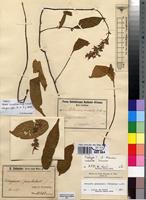
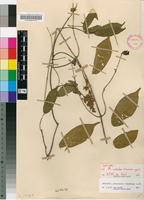
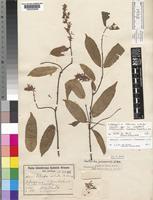
Isotype of Motandra rostrata K.Schum. [family APOCYNACEAE]
Lectotype of Motandra rostrata K.Schum. [family APOCYNACEAE]
Previous
Next

Name

Identification
Isotype of Motandra rostrata K.Schum. [family APOCYNACEAE ] Verified by Not on sheet, Motandra guineensis (Thonn.) A.DC. [family APOCYNACEAE ] (stored under name); Verified by de Kruif A.P.M., 1981
Related name
  • Motandra rostrata
  • Motandra guineensis

Flora

Entry for Motandra rostrata K. Schum. [family APOCYNACEAE]
Herbarium
Royal Botanic Gardens, Kew (K)
Collection
Flora of Tropical Africa
Resource Type
Reference Sources
Entry From
Flora of Tropical Africa, Vol 4, Part 1, page 24, (1904) Author: (By Otto Stapf.)
Names
Motandra rostrata K. Schum. [family APOCYNACEAE], in Schlechter, Westafrik. Kautschuk-Exped. 307.in Engl. Jahrb. xxxiii. 318.
Information
A liane with white flowers. A shrub; branches slender, flattened when young and minutely rusty-tomentose, then terete and brown. Leaves oblong-lanceolate or narrowly linear-oblong, rostrate-acuminate, 1 to almost 4 in. long, 5–15 lin. broad, membranous, glabrous above, bearded in the nerve-axils below; secondary nerves about 5–7 on each side, distinctly prominent below; petioles 2 lin. long. Panicles terminal, about 1 in. long, powdery-subtomentose; pedicels 1 lin. long. Calyx 1 lin. long; sepals ovate, powdery subtomentose. Corolla 2 lin. long; tube 1 lin. long; lobes linear, subfalcate. Anthers 1 1/4 lin. long with a plumose point.
Distribution
Lagos Upper Guinea near Ishagamo, Schlechter, 12312.
Notes
Certainly very near to M. guineensis, if not identical with it,

Related Materials

  • Terms and Conditions
  • Privacy Policy
  • Cookie Policy
  • Cookie Settings
  • Accessibility
  • Help
  • Contact Us
  • Facebook
  • Twitter
ITHAKA

JSTOR is part of ITHAKA, a not-for-profit organization helping the academic community use digital technologies to preserve the scholarly record and to advance research and teaching in sustainable ways.

©2000-2026 ITHAKA. All Rights Reserved. JSTOR®, the JSTOR logo, JPASS®, Aluka®, and ITHAKA® are registered trademarks of ITHAKA.

╳