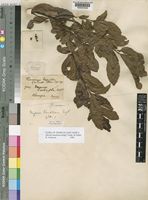
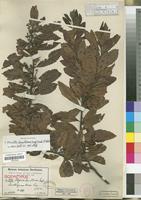
Much-branched almost invariably monoecious shrub or small tree, 1.2–6 m tall; branchlets subglabrous (apart from the glands) to crisped pubescent or densely pilose. Leaf-blades elliptic-oblanceolate to narrowly elliptic or oblong-obovate, up to 5–9.5(–10) cm long and 2–3.2(–4) cm wide, acute to bluntly pointed at the apex, cuneate at the base, usually distinctly (sometimes coarsely) and rather distantly serrate in the upper half or two- thirds, rarely subentire, the leaves of sterile shoots sometimes biserrate or crenate between the teeth, ± glossy, glabrous to pubescent or pilose particularly on the midrib, covered at first with small rather scarious off-white or pale yellow glands, these rather inconspicuous and not leaving pock-marks on the older leaves; lateral nerves 12–20 or more on either side, fine but visible on both surfaces, the ultimate venation rather inconspicuous; petiole 3–8 mm long. Catkins greenish-yellow or greenish-white, 2–5(–7) cm long, soon rather lax; female flowers borne on the upper and greater part of the catkins, rarely the catkins all male; male catkins sometimes rather persistently dense. Male flowers: bracts broadly ovate-triangular to ± transversely rhombic, 1.2–1.5 mm long, ciliate, glandular dorsally; stamens usually 3–6, but sometimes up to 8–10 in some flowers and on male catkins; anthers usually conspicuously papillose. Female flowers: bracts rather narrower and up to 2 mm long, but otherwise as in male; bracteoles 2–4, ovate or obovate, 0.5–0.8 mm long, ciliate; style-arms linear-lanceolate, 1–2 mm long. Fruits blue or grey to blackish-purple but often appear white when dry, ellipsoid-globose, 3.5–4 mm across.