JSTOR Global Plants Home
  • Home
  • Browse
  • About
  • Access
  • Account
    • Saved Items
    • Profile
  • Log in

Global Plants

Skip to Main Content
  • JSTOR Global Plants Home
  • Global Plants

    • Browse
    • About
    • Access
    • Account
      • Saved Items
      • Profile
Log in
  • Browse
  • About
  • Access
  • Account
    • Saved Items
    • Profile
Advanced Search

Compilation
Monotheca buxifolia

6 Images see all

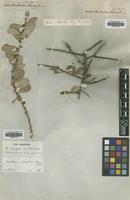
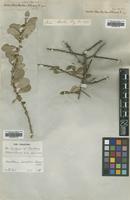
Isosyntype of Monotheca mascatensis A.DC. [family SAPOTACEAE]
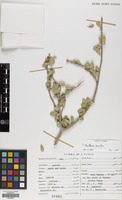
Filed as Sideroxylon mascatense (A.DC.) T.D.Penn. [family SAPOTACEAE]
Isosyntype of Monotheca mascatensis A.DC. [family SAPOTACEAE]
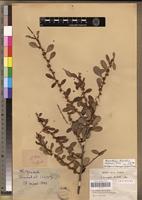
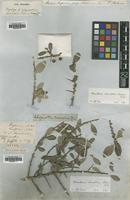
Syntype of Edgeworthia buxifolia Falc. [family SAPOTACEAE]
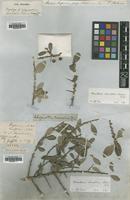
Lectotype of Sideroxylon aubertii A.Chev. [family SAPOTACEAE]
Syntype of Edgeworthia buxifolia Falc. [family SAPOTACEAE]
Previous
Next

Name

Identification
Monotheca buxifolia (Falc.) A.DC. [family SAPOTACEAE ] (stored under name); Monotheca mascatensis A.DC. [family SAPOTACEAE ]
Related name
  • Edgeworthia buxifolia
  • Monotheca mascatensis
  • Monotheca buxifolia
  • Sideroxylon aubertii

Flora

Entry for SIDEROXYLON mascatense (A. DC.) Pennington [family SAPOTACEAE]
Herbarium
Royal Botanic Gardens, Kew (K)
Collection
Flora Somalia
Resource Type
Reference Sources
Entry From
Flora Somalia, Vol 3, (2006) Author: by I. Friis [updated by M. Thulin 2008]
Names
SIDEROXYLON mascatense (A. DC.) Pennington [family SAPOTACEAE], (1985);
Monotheca mascatensis A.DC. [family SAPOTACEAE], (1844);. [type as above]
Reptonia mascatensis (A. DC.) O. Schwartz [family SAPOTACEAE], (1939). [type as above]
Edgeworthia buxifolia Falconer [family ], (1842);
Reptonia buxifolia (Falconer) A.DC. [family SAPOTACEAE], (1844);. [type as above]
Monotheca buxifolia (Falconer) A.DC. [family SAPOTACEAE], (1846). [type as above]
Sideroxylon buxifolium Hutch. [family SAPOTACEAE], (1931);. type: N2, “Shimba Beris, M. Surud”, Collenette 371 (K holo., FT iso.).
Spiniluma buxifolia (Hutch.) Aubrév. [family SAPOTACEAE], (1963);. type: N2, “Shimba Beris, M. Surud”, Collenette 371 (K holo., FT iso.).
Sideroxylon gillettii Hutch. & Bruce [family SAPOTACEAE], (1941);. type: N1, “Mt. Rarele, near Buramo”, Gillett 4733 (K holo., FT iso.).
Information
Spiny shrub or small tree 7–10 m tall, occasionally recorded as a medium-sized tree to 15 m tall; spines in juvenile plants many, thin and leafless, hardly longer than the leaves, in mature plants stronger and longer, and often carrying small clusters of leaves and flowers, or occasionally the plant is unarmed; milky latex usually scarce; branchlets grey, silky, with medifixed hairs. Leaves alternate; petiole 0.4–0.8 cm long; blade leathery, 1–4 x 0.4–2.5 cm, spathulate to elliptic, cuneate at the base, rounded at the apex, margin often recurved, glabrous above, grey, silky below; veins obscure. Inflorescences dense axillary clusters, sometimes in axils of fallen leaves, usually restricted to older branches, sometimes also on older spines; pedicel c. 1 mm long. Flowers c. 2.5 mm long. Calyx 5-lobed, with a short basal tube, with rust-coloured silky hairs; lobes overlapping, broadly ovate with rounded apex, c. 0.8 x 0.6 mm. Corolla 5-lobed, with a short basal tube, yellow; lobes ovate with rounded apex, c. 1 x 0.8 mm. Stamens 5, 1–2 mm long, exceeding the corolla, filaments c. 1 mm long, anthers c. 1 mm long, opening outwards. Ovary globose, silky, c. 0.5 mm in diam., 1-celled with 5 basal ovules on a short placenta. Fruit a 1-seeded berry, 5–8 mm in diam. Seed almost globose, yellowish-brown, c. 5 mm in diam.; scar basal, small and circular.
Range
N1–2
Altitude range
(550–)1500–2100 m.
Distribution
SOMALIA Bally & Melville 16000; Gillett 4624; Hemming 1909.
Distribution (external)
Ethiopia
Djibouti
Saudi Arabia
Yemen
Oman
Afghanistan
Pakistan
Notes
Shaie, sheh, shoy (Som.).The fruits are edible.

Related Materials

  • Terms and Conditions
  • Privacy Policy
  • Cookie Policy
  • Cookie Settings
  • Accessibility
  • Help
  • Contact Us
  • Facebook
  • Twitter
ITHAKA

JSTOR is part of ITHAKA, a not-for-profit organization helping the academic community use digital technologies to preserve the scholarly record and to advance research and teaching in sustainable ways.

©2000-2026 ITHAKA. All Rights Reserved. JSTOR®, the JSTOR logo, JPASS®, Aluka®, and ITHAKA® are registered trademarks of ITHAKA.

╳