

Compilation
Monodora gibsonii
1 Images see all
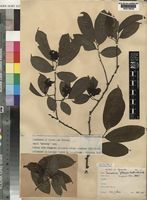
Name
Identification
Monodora gibsonii Bull. ex Burtt Davy [family ANNONACEAE ] Monodora angolensis Welw. [family ANNONACEAE ] (stored under name);
Related name
- Monodora gibsonii
- Monodora angolensis
Flora
Entry for MONODORA angolensis Welw. [family ANNONACEAE]
Herbarium
Royal Botanic Gardens, Kew (K)
Collection
Flora of Tropical East Africa
Resource Type
Reference Sources
Entry From
Flora of Tropical East Africa, page 1, (1971) Author: B. Verdcourt
Names
MONODORA angolensis Welw. [family ANNONACEAE], in Ann. Conselho Ultram. 1858: 587 (1859) & in J.L.S. 3: 151, 154 (1859); Oliv., F.T.A. 1: 38 (1868); Welw. in Trans. Linn. Soc. 27: 10, t. 1 (1869); Engl. & Diels in E.M. 6: 88, t. 29/C (1901); Boutique in F.C.B. 2: 265, t. 24 (1951); R. E. Fries in E. & P. Pf., ed. 2, 17a (2): 168 (1959); Robson in F.Z. 1: 148, t. 16/D (1960); Paiva in Mem. Soc. Brot. 19: 121 (1966); Le Thomas in Fl. Gabon 16, Annonacées: 346, t. 64/1–7 (1969). Type: Angola, Cuanza Norte, Pungo Andongo, Welwitsch 774 (LISC, syn., BM, COI, K, isosyn.!)
Monodora gibsonii Burtt Davy [family ANNONACEAE], Uganda Checklist: 20 (1935); F.P.S. 1: 6 (1950), nom. non rite publ.
Monodora sp. [family ANNONACEAE], sensu I.T.U., ed. 2: 20 (1952)
Information
Shrub or tree 3–20 m. tall, with trunk about 40 cm. in diameter; bark nearly black, vertically shallowly furrowed of rugose; branchlets glabrous. Leaf-blades oblong-elliptic, obovate or oblanceolate, (2.5–)4.5–18(–20) cm. long, (1.5–)2–7(–8.5) cm. wide, acuminate at the apex, cuneate or rounded at the base, subcoriaceous or thin, glabrous, glaucous; venation prominent on both surfaces. Flowers solitary or paired, axillary or extra-axillary, hanging, fragrant; pedicels 1.5–8 cm. long, glabrous; bracteoles round or broadly ovate, 5–10 mm. long and wide, acuminate, amplexicaul, glabrous. Sepals green, tinged or speckled with red or purple, ovate-lanceolate, 0.5–1 cm. long, 3–6 mm. wide, subacute, the margins undulate, sometimes ciliate. Outer petals greenish-yellow or orange spotted with red, white or purple at the base or sometimes purple with yellow veining below, yellow-green with purple mottling above, ovate-oblong, 3–6 cm. long, 1.5–3 cm. wide, obtuse or acute, spreading at the base, curved above with undulate margins, glabrous;inner petals white or pink or tinged yellow, sometimes minutely purple mottled along the margins, often with 2 yellow marks at the base, broadly ovate, rounded or ± sagittate, (0.4–)0.6–1.5 cm. long, (0.5–)0.9–1.5(–1.9) cm. wide, the claw (0.3–)0.6–1 cm. long, attenuate, acute or apiculate at the apex, at first usually connivent, later erect, ciliate, pubescent or glabrous on the margins. Stamens almost round, ± 0.5 mm. long. Ovary conical, ± 1 mm. long, glabrous. Fruiting pedicel ± 3–8 cm. long, thick; fruit hanging, globose or ovoid, 5–9 cm. long, 4.5–7 cm. wide, longitudinally ribbed, rugose, glabrous, the pericarp thick and coriaceous. Seeds chestnut, ovoid or irregularly ellipsoidal, 1–1.5 cm. long, 0.8–1 cm. wide, 7 mm. thick, compressed, smooth and shining. Fig. 28.
Range
DISTR. U1, 2, 4 (see note); T4 Cameroun to Sudan, Zambia and Angola
Altitude range
950–1350 m.
Distribution
TANGANYIKA Kigoma District Kabogo Mts., 3 Dec. 1962, Kyoto Univ. Exped. 308 !UGANDA Bunyoro District Budongo Forest, 15 Feb. 1907, Bagshawe 1490! & Feb. 1930, Gibson 16 ! & same locality, Kasokwa estate, Jardine in Eggeling S555! & same locality, S. Nyakafunjo block, on old road to Budongo gombolola, 2 Jan. 1951, Dawkins 690 !
Notes
A specimen from the Entebbe Botanic Garden, collected on 2 May 1910 (Dawe 993) may have come from a wild plant. Oliv. (F.T.A. 1: 39 (1868)), describes a var. sempervirens based, according to Hiern (Cat. Afr. Pl. Welw. 1: 13 (1896)), on Weiwitsch 774; Hiern calls the typical variety var. decidua and cites Welwitsch 776 and he also describes a var. macrophylla based on Welwitsch 775. Welwitsch 774 and 775 are from Pungo Andongo whereas 776 is from Golungo Alto. They do not seem to be different entities. The specimen from T4 has white petals with green-spotted tips but appears to be this species.