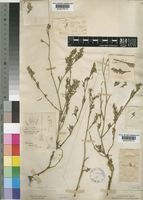
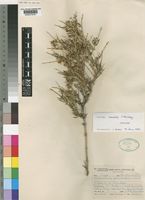
Isotype of Monechma saxatileJ.Munday [family ACANTHACEAE ] (stored under name); Verified by Munday, J., Monechma fimbriatumC.B.Clarke [family ACANTHACEAE ]
Related name
Monechma saxatile
Monechma fimbriatum
Monechma divaricatum
Flora
Entry for MONECHMA fimbriatum C. B. Clarke [family ACANTHACEAE]
Herbarium
Royal Botanic Gardens, Kew (K)
Collection
Flora Capensis
Resource Type
Reference Sources
Entry From
Flora Capensis, Vol 5, page 1, (1912) Author: By C. B. CLARKE.
Names
MONECHMA fimbriatumC. B. Clarke [family ACANTHACEAE]
Information
a pubescent small shrub; branches 14 in. long, frequently divided, quadrangular, many internodes 1 1/2 in. long; leaves 3/4 by 1/16 in., narrowly linear; flowers solitary, approximate in the upper axils; bracteoles 2, 1/5 in. long, linear, the margins most densely fringed by long white many-celled hairs; calyx 1/5 in. long, deeply 5-fid, minutely pubescent and with some gland-headed hairs; corolla 1/3 in. long; one anther-cell much below the other, tailed; pollen ellipsoid with 2 stopples and 1 obscure row of tubercles on either side of each stopple; capsule 1/3 in. long, sparsely and minutely hairy, 2-seeded; seeds smooth. null
Range
Also lately collected by Schlechter in Tropical Transvaal.
Distribution
EASTERN REGION Natal; without precise locality, Gerrard, 1269!
Notes
The dense white fringe to the bracteoles in Gerrard, 1269, catches the eye at once; the fringe is less prominent in Schlechter's plant.