JSTOR Global Plants Home
  • Home
  • Browse
  • About
  • Access
  • Account
    • Saved Items
    • Profile
  • Log in

Global Plants

Skip to Main Content
  • JSTOR Global Plants Home
  • Global Plants

    • Browse
    • About
    • Access
    • Account
      • Saved Items
      • Profile
Log in
  • Browse
  • About
  • Access
  • Account
    • Saved Items
    • Profile
Advanced Search

Compilation
Mikania batatifolia

7 Images see all

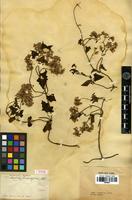
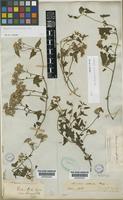
Type of Mikania batatifolia DC. [family ASTERACEAE]
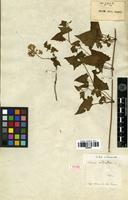
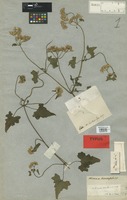
Type of Mikania poeppigii DC. [family ASTERACEAE]
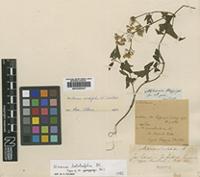
Mikania batatifolia DC. [family COMPOSITAE]
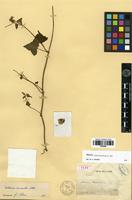
Holotype of Mikania batatifolia DC. [family COMPOSITAE]
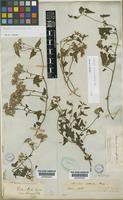
Type of Mikania batatifolia DC. [family ASTERACEAE]
Previous
Next

Name

Identification
Mikania batatifolia DC. [family ASTERACEAE ] (stored under name); Verified by Walter C. Holmes, Mikania poeppigii DC. [family ASTERACEAE ] Verified by Walter C. Holmes, Mikania cordifolia (L.f.) Willd. [family ASTERACEAE ] Verified by A.H.B. Liogier,
Related name
  • Mikania batatifolia
  • Mikania deltoides
  • Mikania scandens
  • Mikania cordifolia
  • Mikania orinocensis
  • Mikania poeppigii
  • Mikania micrantha

Flora

Entry for Mikania batatifolia de Candolle [family COMPOSITAE]
Herbarium
Flora of North America (FNA)
Collection
Flora of North America
Resource Type
Reference Sources
Entry From
Flora of North America, Vol 21,
Names
Mikania batatifolia de Candolle [family COMPOSITAE], in A. P. de Candolle and A. L. P. P. de Candolle, Prodr., 5: 197. 1836
Past names
batataefolia
Treatment Author(s)
Walter C. Holmes
Information
Stems obscurely 6-angled, sometimes winged on angles, often densely glandular, glabrous or puberulent; internodes 3.5–13 cm. Petioles 10–40 mm, glabrous, glandular. Leaf blades deltate-ovate, 1.5–6 × 1–5 cm, (subcoriaceous to somewhat fleshy) bases cordate to subcordate, margins usually hastately dentate to ± lobed (lobes divergent), apices acute to acuminate, faces glabrous (and gland-dotted). Arrays of heads corymbiform, 2–4 × 2–6 cm. Heads 4–6 mm. Phyllaries lanceolate to narrowly ovate, ca. 3.5 mm, apices acuminate (abaxial faces puberulent). Corollas white, ca. 3 mm, gland-dotted, lobes deltate. Cypselae brown, 1.5–2 mm, densely gland-dotted; pappi of ca. 40 white, barbellate bristles ca. 3 mm.
Phenology
year round
Distribution
West Indies (Bahamas).West Indies (Cuba).USA Fla.
Discussion
J. K. Small (1933), B. L. Robinson (1934), R. W. Long and O. Lakela (1971), and W. C. Holmes (1981, 1993) recognized Mikania batatifolia. Hn. Alain (1962) referred M. batatifolia to M. micrantha Kunth, a common, polymorphic taxon of humid American tropics. A. Cronquist (1980) merged M. batatifolia with M. scandens. In reexamining the members of the M. scandens complex, which includes M. batatifolia (Robinson), it is apparent that M. batatifolia is distinct. Differences with M. scandens, including chemical evidence, were cited by Holmes (1981). For additional information, see Holmes (1981, 1993).

Related Materials

  • Terms and Conditions
  • Privacy Policy
  • Cookie Policy
  • Cookie Settings
  • Accessibility
  • Help
  • Contact Us
  • Facebook
  • Twitter
ITHAKA

JSTOR is part of ITHAKA, a not-for-profit organization helping the academic community use digital technologies to preserve the scholarly record and to advance research and teaching in sustainable ways.

©2000-2026 ITHAKA. All Rights Reserved. JSTOR®, the JSTOR logo, JPASS®, Aluka®, and ITHAKA® are registered trademarks of ITHAKA.

╳