JSTOR Global Plants Home
  • Home
  • Browse
  • About
  • Access
  • Account
    • Saved Items
    • Profile
  • Log in

Global Plants

Skip to Main Content
  • JSTOR Global Plants Home
  • Global Plants

    • Browse
    • About
    • Access
    • Account
      • Saved Items
      • Profile
Log in
  • Browse
  • About
  • Access
  • Account
    • Saved Items
    • Profile
Advanced Search

Compilation
Micrococca scariosa

3 Images see all

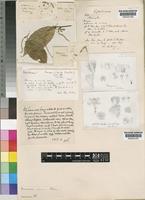
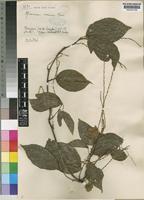
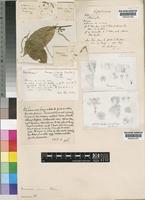
Micrococca scariosa Prain [family EUPHORBIACEAE]
Previous
Next

Name

Identification
Micrococca scariosa Prain [family EUPHORBIACEAE ] (stored under name);
Related name
  • Claoxylon unrecorded
  • Micrococca scariosa
  • Micrococca unrecorded

Flora

Entry for MICROCOCCA scariosa Prain [family EUPHORBIACEAE]
Herbarium
Royal Botanic Gardens, Kew (K)
Collection
Flora of Tropical Africa
Resource Type
Reference Sources
Entry From
Flora of Tropical Africa, Vol 6, Part 1, page 441, (1913) Author: (By J. G. Baker, with additions by C. H. Wright.)
Names
MICROCOCCA scariosa Prain [family EUPHORBIACEAE], in Kew Bulletin, 1912, 192.
Information
Shrub 4–7 ft. high; twigs reddish-brown, glabrous. Leaves short-petioled, rather firmly membranous, ovate-oblong, acute or shortly acuminate, base rounded, 2-glandular, margin remotely crenate-toothed or nearly entire, 3–5 in. long, 1 1/4–2 1/4 in. wide, rather pale green especially beneath, glabrous on both surfaces; lateral nerves 5–6 pairs, ascending; petiole glabrous, 1/8– 1/3 in. long; stipules subulate, 2 1/2 lin. long. Flowers in lateral diœcious filiform spikes, leaf-opposed or on nodes below the leaves, 2–6 in. long; rhachis green, faintly trigonous, rather rigid, glabrous; bracts rigid, lanceolate, 1–3 lin. apart; bracteoles of male racemes scarious, numerous to each bract, enveloping the pedicels of the numerous flowers which open singly and quickly disarticulate and disappear, bracteoles of female racemes 2 to a bract, subtending solitary flowers; pedicels articulate, of male flowers 1 lin. long, flattened below the joint with their angles minutely ciliolate, of female flowers ultimately 2 lin. long. Male calyx white, glabrous, ovoid-globose in bud; lobes 2–3, dividing half-way or rather lower. Stamens 21–24; filaments rather long, free, glabrous, mixed with as many ovoid receptacular glands, hirsute at the top with long hairs, or glabrous. Female sepals 5, free, ovate, acute, their margins ciliolate, otherwise glabrous. Ovary glabrous, 3-celled; stigmas 3, linear, plumosely fimbriate at the apex only. Disk of 6 free but contiguous short broad scales. Capsule pale straw-colour, 3-coccus; cocci separating septicidally.
Distribution
German East Africa Mozamb. Dist. Amboni, near Tanga, Sacleux, 1630 (coll. 1897)! Mouyouni, Sacleux, 1630 (coll. 1891)!

Related Materials

  • Terms and Conditions
  • Privacy Policy
  • Cookie Policy
  • Cookie Settings
  • Accessibility
  • Help
  • Contact Us
  • Facebook
  • Twitter
ITHAKA

JSTOR is part of ITHAKA, a not-for-profit organization helping the academic community use digital technologies to preserve the scholarly record and to advance research and teaching in sustainable ways.

©2000-2026 ITHAKA. All Rights Reserved. JSTOR®, the JSTOR logo, JPASS®, Aluka®, and ITHAKA® are registered trademarks of ITHAKA.

╳