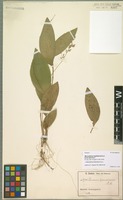
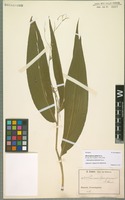
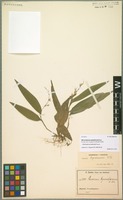
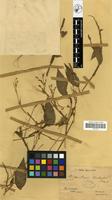
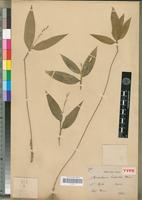
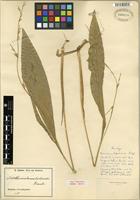
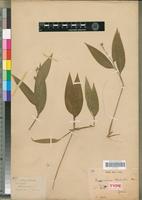
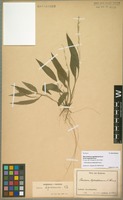
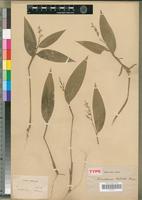
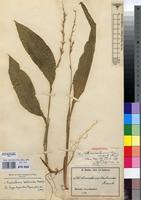
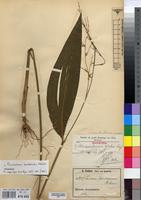
Racemes slender, sheathed at the base by about 4 cataphylls, the lowest firm, very short, rounded, very strongly nerved, the following similar, but up to 3 1/2 lin. long, the third and fourth thinner and much elongated (the latter up to 1 1/2 in. long), all more or less appressedly hairy, at length glabrescent, the internode above the uppermost cataphyll often much elongated and up to 1 ft. long, prostrate or inclined, ending in a motile knee and sometimes rooting from it, followed above it by a succession of short sheathed internodes forming an erect leafy and flowering culm, which rarely rises over 1/2 ft. above the knee; innovation-buds extravaginal from the knee, growing out into runners or directly into secondary leafy culms. Leafy or flowering culms few- to 8-noded, with all their leaves normal foliage-leaves or (on secondary culms) the lowest 2 or 3 of them developed as cataphylls, usually all the internodes except the uppermost enclosed in the sheaths. Leaf-sheaths very tight, firm, terete, strongly striate, appressedly hairy between the nerves and with a dense transverse dorsal line of hairs at the junction with the blade; ligules obscure; blades broad-lanceolate, acutely acuminate, 2–4 in. by 2/3–1 in., rather firm and somewhat rigid, shortly contracted at the base, glabrous above, finely and appressedly pubescent below towards the base, rarely higher up, at length often quite glabrous, midrib very slender, somewhat prominent below downwards, obscure above, lateral nerves close, 60–70 per inch; epidermal cells small with rather stout straight more or less pitted lateral walls. Inflorescence shortly exserted, from less than 1 to almost 3 in. long; lower primary branchlets 2 1/2–4 lin. long (excluding the spikelets), seldom longer, rarely with more than 3 perfect spikelets, upper reduced to 2-nate or solitary spikelets; axes filiform, more or less angular, finely pubescent or scaberulous; pedicels very unequal, the longest up to 3 lin. long. Spikelets oblong to lanceolate-oblong, 3–3 1/4 lin. long; the glumes and the lower floret more or less purplish. Lower glume from slightly over 1 to 1 1/2 lin. long, 5-nerved; upper 2 lin. long, 7-nerved. Lower floret slightly shorter than the upper, ♂: valve obliquely lanceolate-oblong in profile, subacuminate. Upper floret: valve whitish or very faintly suffused with purple, lanceolate in profile, bluntly rostrate-acuminate, glabrous except for the marginal cilia and the silky basal beard, the hairs of which are about 1/2 lin. long. Anthers 1 1/4 lin. long.