JSTOR Global Plants Home
  • Home
  • Browse
  • About
  • Access
  • Account
    • Saved Items
    • Profile
  • Log in

Global Plants

Skip to Main Content
  • JSTOR Global Plants Home
  • Global Plants

    • Browse
    • About
    • Access
    • Account
      • Saved Items
      • Profile
Log in
  • Browse
  • About
  • Access
  • Account
    • Saved Items
    • Profile
Advanced Search

Compilation
Microcalamus aspidistrula

6 Images see all

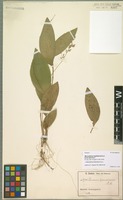
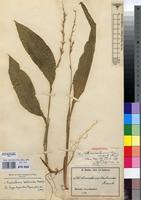
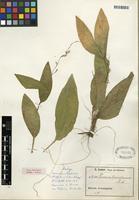
Isotype of Microcalamus aspidistrula Stapf forma latus Stapf [family POACEAE]
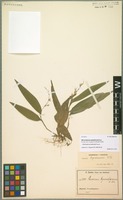
Syntype of Microcalamus aspidistrula Stapf [family POACEAE]
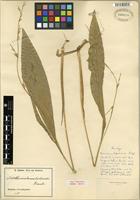
Isosyntype of Microcalamus aspidistrula Stapf [family POACEAE]
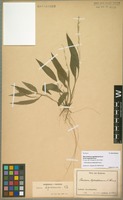
Syntype of Microcalamus aspidistrula Stapf forma angustus Stapf [family POACEAE]
Isosyntype of Microcalamus aspidistrula Stapf [family POACEAE]
Isotype of Microcalamus aspidistrula [unranked] latus Stapf [family POACEAE]
Previous
Next

Name

Identification
Microcalamus aspidistrula Stapf [family POACEAE ] Verified by Not on sheet, Microcalamus barbinodis Franch. [family POACEAE ] (stored under name); Verified by Not on sheet,
Related name
  • Microcalamus aspidistrula
  • Microcalamus barbinodis

Flora

Entry for MICROCALAMUS Aspidistrula Stapf [family ]
Herbarium
Royal Botanic Gardens, Kew (K)
Collection
Flora of Tropical Africa
Resource Type
Reference Sources
Entry From
Flora of Tropical Africa, Vol 9, page 1, (1917) Author: (By O. STAPF.)
Names
MICROCALAMUS Aspidistrula Stapf [family ], in Hook. Ic. Pl. sub t. 3070 (partly).
Information
The whole plant 1/2 to almost 2 ft. high; innovations extravaginal, rooting from the base, 1–7 in. long, with 3–4 cataphylls, the lowest of them very short, rounded, the second 1/2–1 in. long, loosely sheathing, the following separated by an internode ultimately up to over 1/2 in. long, all silky at the nodes, otherwise mostly appressedly hairy between the nerves and ciliate along the margins or ciliate only or quite glabrous, quite bladeless, the uppermost 1 to over 6 in. long; the innovations growing out either directly into an erect or suberect leafy flowering culm or by the elongation of the first internode above the uppermost cataphyll into an inclined or arched runner-like or subprostrate base, sometimes over 1 ft. long, frequently rooting from its terminal node and throwing up from it an erect leafy culm or—by the formation of extravaginal buds—a scanty fascicle of leafy culms; these secondary culms sheathed at the base with 2 or 3 cataphylls and reduced in size, but otherwise repeating the characters of the primary. Perfect leaves 1–3; sheaths tight, firm, appressedly or loosely pubescent or glabrous between the prominent nerves, always silky-pubescent at the nodes and with a ciliate dorsal transverse rim at the junction with the blade; ligules a transverse firm ciliolate rim; blades lanceolate, subsymmetrical or somewhat oblique, gradually tapering from the middle or slightly below it towards both ends, 4 to almost 12 in. by 1–2 in., moderately firm, glabrous above, finely and appressedly pubescent underneath, midrib slender, prominent below, lateral nerves 35–50 per inch. Inflorescence long-exserted, 3–9 in. long; lower primary branches 1–3 in. apart and 1–3 in. long, with up to 6 spikelets, or if more (long branches) then usually some of them arrested; axes filiform, angular, minutely puberulous or pubescent, or, at the nodes, almost villosu lous; pedicels very unequal, the longest up to 2, or the terminal up to over 3 lin. long, scaberulous to puberulous, tips sometimes discoid. Spikelets 3 to almost 4 lin. long, very like those of M. barbinodis, if not occasionally more slender and much paler. Lower glume often 7-nerved. Fertile valve sometimes pubescent up to beyond the middle.
Distribution
Gaboon Lower Guinea Sierra del Crystal, Mann, 1646!Cameroons Upper Guinea in forests near Bipinde, Zenker, 1834! 2144! 3193!
Notes
Whilst the specific identity of the specimens quoted above is fairly clear, that of the following might at the first glance be thought doubtful owing to the striking differences in the shape of the leaf-blades. A close examination, however, especially also of the anatomical characters of the epidermis of the leaves, shows so much agreement that it is more probable that these variations are only of the fluctuation type, if not due to conditions of illumination or some such factor. They may be described thus:—

Related Materials

  • Terms and Conditions
  • Privacy Policy
  • Cookie Policy
  • Cookie Settings
  • Accessibility
  • Help
  • Contact Us
  • Facebook
  • Twitter
ITHAKA

JSTOR is part of ITHAKA, a not-for-profit organization helping the academic community use digital technologies to preserve the scholarly record and to advance research and teaching in sustainable ways.

©2000-2026 ITHAKA. All Rights Reserved. JSTOR®, the JSTOR logo, JPASS®, Aluka®, and ITHAKA® are registered trademarks of ITHAKA.

╳