JSTOR Global Plants Home
  • Home
  • Browse
  • About
  • Access
  • Account
    • Saved Items
    • Profile
  • Log in

Global Plants

Skip to Main Content
  • JSTOR Global Plants Home
  • Global Plants

    • Browse
    • About
    • Access
    • Account
      • Saved Items
      • Profile
Log in
  • Browse
  • About
  • Access
  • Account
    • Saved Items
    • Profile
Advanced Search

Compilation
Mesembryanthemum ciliatum

4 Images see all

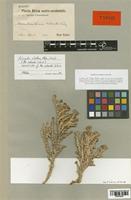
Isosyntype of Mesembryanthemum schenckii Schinz [family AIZOACEAE]
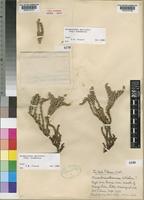
Brownanthus marlothii Schwantes [family AIZOACEAE]
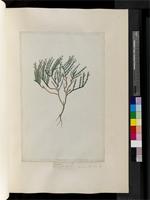
Mesembryanthemum ciliatum Aiton, from South Africa
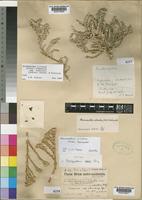
Lectotype of Mesembryanthemum schenckii Schinz [family AIZOACEAE]
Previous
Next

Name

Identification
Mesembryanthemum ciliatum Aiton [family AIZOACEAE ]
Related name
  • Mesembryanthemum ciliatum

Flora

Entry for MESEMBRYANTHEMUM ciliatum Thunb. [family AIZOACEAE]
Herbarium
Royal Botanic Gardens, Kew (K)
Collection
Flora Capensis
Resource Type
Reference Sources
Entry From
Flora Capensis, Vol 2, page 386, (1894) Author: (BY W. SONDER.)
Names
MESEMBRYANTHEMUM ciliatum Thunb. [family AIZOACEAE], ! R. c. p. 11. App.;—Flor. Cap. 416.
Information
stem and branches smooth; branches secundate, erect-spreading, terete, articulate, not contracted at the joints; leaves connate, a little sheathing, sheaths at the base ciliated with long deflexed hairs; leaves subcylindrical, obtuse, papillose; flowers terminal, short, peduncled, subcymose; calyx lobes 5, equal, obtuse, subpapulose, nearly equalling the white petals. Stem 1 foot. Branches fastigiate. Articles cylindrical. 4–6 lines long. Sheaths of the leaves nearly 1 line long, ciliated, with 1–1 1/2 line long hairs at the base, not at the top. Leaves as long as the articles or longer. Flowers on the tops of the branchlets; peduncles 1–1 1/2 lines long. Calyx 3 lines long, a little shorter than the very narrow-linear petals. Capsule as large as a small pea, 5-valved.
Distribution
SOUTH AFRICA Karro, between Olifantsriver and Bocklandsberg. Oct.-Nov. (Herb. Thunb.)

Related Materials

  • Terms and Conditions
  • Privacy Policy
  • Cookie Policy
  • Cookie Settings
  • Accessibility
  • Help
  • Contact Us
  • Facebook
  • Twitter
ITHAKA

JSTOR is part of ITHAKA, a not-for-profit organization helping the academic community use digital technologies to preserve the scholarly record and to advance research and teaching in sustainable ways.

©2000-2026 ITHAKA. All Rights Reserved. JSTOR®, the JSTOR logo, JPASS®, Aluka®, and ITHAKA® are registered trademarks of ITHAKA.

╳