JSTOR Global Plants Home
  • Home
  • Browse
  • About
  • Access
  • Account
    • Saved Items
    • Profile
  • Log in

Global Plants

Skip to Main Content
  • JSTOR Global Plants Home
  • Global Plants

    • Browse
    • About
    • Access
    • Account
      • Saved Items
      • Profile
Log in
  • Browse
  • About
  • Access
  • Account
    • Saved Items
    • Profile
Advanced Search

Compilation
Melinis maitlandii

5 Images see all

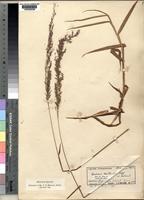
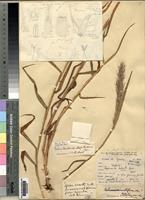
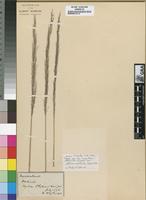
Isotype of Melinis maitlandii Stapf & C.E.Hubb. [family POACEAE]
Isotype of Melinis intermedia Stapf & C.E.Hubb. [family POACEAE]
Holotype of Melinis intermedia Stapf & C.E.Hubb. [family POACEAE]
Holotype of Melinis maitlandii Stapf & C.E.Hubb. [family POACEAE]
Type of Melinis maitlandii Stapf & C.E.Hubb. [family POACEAE]
Previous
Next

Name

Identification
Melinis maitlandii Stapf & C.E.Hubb. [family POACEAE ] Verified by Not on sheet, Melinis minutiflora P.Beauv. [family POACEAE ] (stored under name); Verified by Not on sheet,
Related name
  • Melinis maitlandii
  • Melinis ambigua
  • Melinis intermedia
  • Melinis minutiflora
  • Melinis tenuinervis

Flora

Entry for MELINIS Maitlandii Stapf & Hubbard [family POACEAE]
Herbarium
Royal Botanic Gardens, Kew (K)
Collection
Flora of Tropical Africa
Resource Type
Reference Sources
Entry From
Flora of Tropical Africa, Vol 9, page 1, (1917) Author: (By O. STAPF.)
Names
MELINIS Maitlandii Stapf & Hubbard [family POACEAE], in Kew Bulletin, 1926, 445.
Information
Perennial. Culms erect or geniculately ascending, 2–2 1/2 ft. or more long, moderately stout, terete, many-noded, glabrous or slightly hairy near the nodes. Leaves sparsely to densely and coarsely hirsute with tubercle-based hairs; sheath loose, overlapping, finely striate, hairs spreading or reflexed, nodes bearded; ligule reduced to a white ciliate rim with hairs about 1/2 lin. long; blade linear, narrowed at the base, long and finely acute, 3–6 in. long, 3–4 lin. wide, the uppermost usually shorter and narrower, firm, flat, rarely involute, margins shortly ciliate and scaberulous. Panicle linear-oblong, 5–8 in. long, 1/2– 3/4 in. wide, erect, dense, sheathed at the base or exserted, pale yellowish-green, purple or variegated green and purple, with purplish awns; branches 2–3-nate, erect; ramifications flexuous, capillary, purplish, minutely and obscurely scaberulous; pedicels 1/2–1 lin. long, with slightly thickened paler glabrous tips. Spikelets linear-oblong, about 1 lin. long, strongly grooved and nerved, pale yellowish-green, purple or tinged with purple upwards, long pilose in the upper part. Lower glume reduced to an annular rim or an ovate, obtuse or acute hyaline scale up to 1/8 lin. long, nerveless, hairy from the base, hairs up to 1/2 lin. long; upper oblong when flattened, as long as the spikelet, very shortly 2-lobed, lobes rounded, with or without a mucro, membranous, glabrous or hairy on the margins below, sparsely pilose from the middle upwards with long white partly tubercle-based hairs exceeding the spikelet by 1/2 lin., 7-nerved. Lower floret barren: valve narrowly oblong when flattened, as long as the upper glume and similar in hairiness and texture, 2-lobed with the lobes narrow, acute and one-fifth the length of the valve, with a straight or flexuous awn 3–6 lin. long from the sinus, 5-nerved; valvule 0. Upper floret hermaphrodite: valve ovate-oblong, 3/5– 4/5 lin. long, obscurely 1–3-nerved, hyaline, minutely 2-fid; valvule of similar shape, size and texture; anthers linear-oblong, 3/5 lin. long.
Distribution
Nyasaland Mozamb. Dist. Nyika Plateau, 6000–7000 ft., Whyte! Livingstonia (Kondowe) to Karonga, 2000–6000 ft., Whyte !Uganda Nile Land Sese Islands, Bufumira, 3700 ft., in open growing glades near forest, Maitland, 360! Ruwenzori, common in forests, 6000–8000 ft., Scott Elliot, 7566! Ankole; Ibanda Hill, in short grass savannah, 6000 ft., Snowden, 1397! Kigezi; Kashambia, on sides of road-cuttings or on banks amongst bushes, 5500 ft., Snowden, 1296!
Notes
Maitland states that this grass gives off, during the warm part of the day, a peculiar odour resembling that of linseed oil. Vern. Name, Kifuta (Maitland).

Related Materials

  • Terms and Conditions
  • Privacy Policy
  • Cookie Policy
  • Cookie Settings
  • Accessibility
  • Help
  • Contact Us
  • Facebook
  • Twitter
ITHAKA

JSTOR is part of ITHAKA, a not-for-profit organization helping the academic community use digital technologies to preserve the scholarly record and to advance research and teaching in sustainable ways.

©2000-2026 ITHAKA. All Rights Reserved. JSTOR®, the JSTOR logo, JPASS®, Aluka®, and ITHAKA® are registered trademarks of ITHAKA.

╳