

Compilation
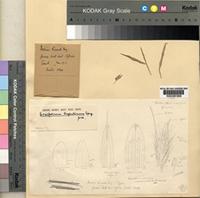
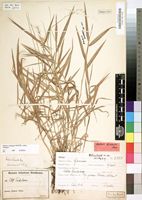
Melinis hirsuta
2 Images see all
Name
Identification
Melinis hirsuta Mez [family GRAMINEAE ] Verified by Not on sheet., Melinis ambigua Hack. [family GRAMINEAE ] (stored under name); Verified by Not on sheet.,
Related name
- Melinis hirsuta
- Tricholaena unrecorded
- Melinis ambigua
Flora
Entry for MELINIS ambigua Hack. [family POACEAE]
Herbarium
Royal Botanic Gardens, Kew (K)
Collection
Flora of Tropical East Africa
Resource Type
Reference Sources
Entry From
Flora of Tropical East Africa, page 451, (1982) Author: W. D. CLAYTON and S.A. RENVOIZE
Names
MELINIS ambigua Hack. [family POACEAE], in Oest. Bot. Zeitschr. 51: 462 (1901); F.T.A. 9: 921 (1930); Fl. Agrost. Congo Belge 2: 311 (1934); F.P.N.A. 3: 120 (1955);R.K.G.: 50 (1958); Ann. list Nyasaland grasses: 48 (1958); G.T.: 80 (1965). Type: Ethiopia, Amba Harres Mt., Schimper 800 (K, iso.!)
Panicum longicaudum Mez [family POACEAE], in E.J. 34: 133 (1904). Type: Tanzania, L. Tanganyika to L. Rukwa, Nutt (K, iso.!)
Rhynchelytrum longicaudum (Mez) Chiov. [family POACEAE], in Nuov. Giorn. Bot. Ital., n.s., 26: 78 (1919)
Melinis goetzenii Mez [family POACEAE], in E.J. 57: 198 (1921); F.T.A. 9: 920 (1930). Type: Rwanda, Kirunga Plateau, Goetzen 22 (B, holo.)
Melinis diminuta Mez [family POACEAE], in E.J. 57: 200(1921). Type: Tanzania, Rungwe, Stolz 1299 (K, isolecto.!)
Melinis hirsuta Mez [family POACEAE], in E.J. 57: 201 (1921). Type: Namibia, Gaub, Dinter 2394 (B, holo., K, photo.!)
Melinis mollis Stapf & Hubbard [family POACEAE], in K.B. 1926: 440 (1926); F.T.A. 9: 920 (1930). Type: Angola, Cassoalala, Gossweiler 8925 (K, holo.!)
Melinis longicauda (Mez) Stapf & Hubbard [family POACEAE], in F.T.A. 9: 919 (1930); Ann. list Nyasaland grasses: 48 (1958); G.T.: 80 (1965)
Rhynchelytrum shantzii Stapf & Hubbard [family POACEAE], in F.T.A. 9: 892 (1930); Fl. Agrost. Congo Belge 2: 302 (1934). Type: Zaire, Kalule Sud, Shantz 538 (K, holo.!)
Rhynchelytrum bequaertii Robyns [family POACEAE], in B.J.B.B. 9: 193 (1932), nom. superfl. Based on Panicum longicaudum Mez
Melinis inamoena Pilg. [family POACEAE], in N.B.G.B. 13: 262 (1936). Type: Tanzania, Njombe District, Lupembe, Schlieben 736 (B, holo.!)
Information
Tufted or geniculately ascending perennial; culms 60–120 cm. high. Leaf-blades flat or occasionally involute, 5–20 cm. long, 2–10 mm. wide, glabrous to softly pilose, ± sticky. Panicle oblong, 5–20 cm. long; pedicels puberulous, with or without long hairs near the tip. Spikelets narrowly oblong, (2–)2.5–4 mm. long, silky pilose from long pink, purple or silvery hairs (commonly tubercle-based) exceeding the tip by 1–4 mm.; lower glume a little oblong scale 0.5–1 mm. long; upper glume straight on the back, 7-nerved, these sometimes forming shallow ribs, with an abrupt transition between the chartaceous hairy body and the membranous glabrous tip, scaberulous on the margins, obtusely or acutely bilobed, with an awn 1–7 mm. long (rarely awnless but then the glume over 2.5 mm. long); lower floret barren, with or without a palea (its keels scaberulous), the lemma similar to the upper glume but 5-nerved and with an awn 3–12 mm. long.
Range
DISTR. K4/6; T2–4, 6–8 Ethiopia, southward to Zimbabwe
Altitude range
1100–2100 m.
Distribution
KENYA Machakos/Masai District Chyulu Hills, 4 May 1938, Bally 8128!TANZANIA Iringa District Mufindi, 6 Feb. 1972, Pedersen 908! & near Lake Ngowasi, 7 May 1968, Renvoize & Carr 1967 !TANZANIA Songea District Miyau, 21 May 1956, Milne-Redhead & Taylor 10398!
Notes
A variable species, customarily divided into two according to whether the lower palea is present or not. The presence of a palea tends to be associated with longer spikelets, but is not well correlated with other characters, and the distinction seems artificial.At one extreme it grades into M. minutiflora, being distinguished by the larger hairy spikelets which are nearly always 2-awned, and by the membranous tip to the lower lemma. At the other extreme it is sometimes difficult to separate from Rhynchelytrum scabridum and R. longisetum, its 7-nerved upper glume being the most reliable distinguishing character.Rare specimens with the keels of the lower palea ciliate suggest introgression from R. repens.