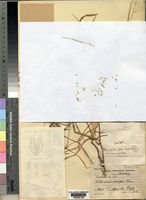
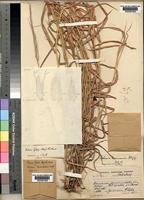
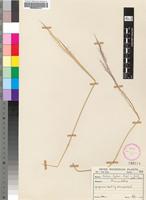
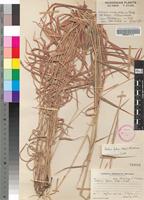
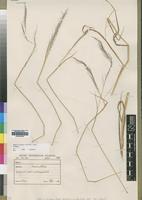
Perennial. Culms tufted, erect or ascending from a short rhizome, 3 1/2–4 ft. or more long, terete, hard, slender, rarely branched, in the greater part pubescent to pilose with erect spreading or reflexed white hairs, glabrous towards the panicle, many-noded with the nodes villous, the lower internodes short, increasing in length upwards. Lower leaf-sheaths more or less persistent, tight, shorter than the internodes, the upper becoming looser, larger and overlapping towards the panicle, finely striate, minutely tubercled, hairy like the culms and villous at the nodes, or the uppermost sheath sometimes glabrous; ligule reduced to a white ciliate rim with hairs about 1/2 lin. long; blade linear, narrowed at the base, finely and long-acute, 3–6 in. long, 2 1/2–3 lin. wide, flat, dull green, softly tomentose above and below, sparsely fimbriate with tubercle-based hairs and short cilia. Panicle 6–7 in. long, linear, contracted, purplish, all parts minutely and obscurely scaberulous; branches erect, fine, 1–3-nate, twice-divided; branchlets and pedicels flexuous, capillary, the latter 1/2–1 1/2 lin. long, with silky white hairs 1/4– 1/2 lin. long from below their slightly thickened paler tips. Spikelets oblong, 1 1/4–1 1/3 lin. long, shortly and sparsely pilose, pale green below, tinged with purple upwards. Lower glume ovate, acute or obtuse, 1/5– 1/4 lin. long, obscurely 1-nerved or nerveless, glabrous, hyaline; upper broadly oblong when flattened, as long as the spikelet, acutely 2-lobed with the lobes glabrous and equalling one-fourth the length of the glume and with a flexuous green awn, 2–3 lin. long, from the sinus, membranous, sparsely hairy upwards especially towards the margin with white, short but distinct hairs, 7-nerved. Lower floret barren: valve narrowly oblong when flattened, 1 lin. long, similar to the upper glume in texture and hairiness, finely 5-nerved, 2-lobed with the lobes acute, one-third the length of the valve and with a fine flexuous awn 4–5 lin. long from the sinus; valvule 0. Upper floret hermaphrodite: valve ovate, obtuse, 1 lin. long, obscurely 3-nerved, minutely 2-fid, apex minutely ciliate; valvule of similar size and shape, obtuse.