

Compilation
Melhania volleseniana
1 Images see all
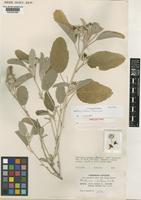
Name
Identification
Melhania velutina Forssk. [family STERCULIACEAE ] Melhania volleseniana Dorr [family STERCULIACEAE ] (stored under name); Verified by Dorr, L.J.,
Related name
- Melhania velutina
- Melhania volleseniana
Flora
Entry for Melhania volleseniana Dorr [family STERCULIACEAE]
Herbarium
Royal Botanic Gardens, Kew (K)
Collection
Flora of Tropical East Africa
Resource Type
Reference Sources
Entry From
Flora of Tropical East Africa, page 1, Author: MARTIN CHEEK AND LAURENCE DORR
Names
Melhania volleseniana Dorr [family STERCULIACEAE], sp. nov. a M. ovata Cav. indumento lanato densiore, stipulis longioribus persistentibusque, segmentis epicalycis longioribus lateralibusque et sepalis longioribus differt. Typus: Kenya, Northern Frontier District: Kailongol Mts, Mathew 6818 (K!, holo.)
“Melhania sp. = Thesiger 1945” [family ], [in Vollesen in Fl. Eth. 2(2): 173 (1995); Thulin, Fl. Som. 2: 24 (1999)]
Information
Annual or perennial herb to 0.5 m tall; erect; stems whitish lanate. Leaves ovate to widely elliptic, 2.5–7 cm long, 1.5–4.5 cm wide, apex subacute, apiculate, or truncate, margin dentate to serrate, base truncate, weakly to strongly discolorous, green to greyish pubescent above, densely greyish-white lanate below, palmately 3–5-nerved from the base; petiole 0.5–3 cm long, whitish lanate; stipules filiform, 0.8–2 cm long, persistent, sparsely to densely whitish-stellate pubescent. Inflorescences 2–3-flowered cymes, or flowers solitary; peduncle 1–2(–3.5) cm long, ± 1.5 mm wide; pedicels to 1 cm long; peduncle and pedicels tomentose to lanate; epicalyx bracts subulate to linear or narrowly lanceolate, (8–)10–20 mm long, 1–2(–3) mm wide, most ± as long as the the sepals or slightly longer, tomentose, erect. Floral buds narrowly ovoid, the sepal apices free. Sepals subulate, (9–)11–18 mm long, 3–4 mm wide, long-acuminate, tomentose to lanate without and within above, glabrous toward the base, individual hairs long-stalked stellate. Petals obovate, slightly asymmetrical, 6–10 mm long, 3.5–4 mm wide, yellow or pale yellow, glabrous. Staminal tube 1–1.5 mm long, free portion of filaments ± 1.5 mm long, anthers ± 1.5 mm long, free portion of staminodes 4–6 mm long, glabrous. Ovary subglobose, 3.5–4 mm long, 3.5–4 mm in diameter, densely white-velutinous; 6 ovules per locule; style 2–3 mm long, sometimes with a few scattered white stellate hairs; stigma lobes 1–1.5 mm long, erect, becoming recurved. Capsules ovoid, 7–9 mm long, 6–9 mm in diameter, tomentose; 4(–6) seeds per locule; seed trigonal with two flat and one rounded surface, 1.5–2 mm long, 1–1.5 mm wide, tuberculate, without an elaiosome. Fig. 14/10–12, p. 85.
Range
DISTR. K 1, 2, 4
Altitude range
290–700 m
Distribution
KENYA Northern Frontier District Kailongol Mts, 15 June 1971, Mathew 6818!KENYA Turkana District Lokitunyalla, July 1932, Champion T.146!KENYA Meru District Meru National Park, Kiolu R. crossing, 25 Dec. 1972, Gillett 20145!
Distribution (external)
Somalia
southern Ethiopia
Notes
CONSERVATION This species appears to be on the brink of the rating “threatened” since it is known from only ± 15 sites: only a single collection is known from Somalia and nine from the FTEA area. Its habitat is threatened in at least part of its range in Kenya (K1: see under Hernmannia pseudathiensis). Accordingly it is rated here as “near threatened”. Related to M. ovata, but differing in having a denser, lanate indumentum, longer and persistent stipules, longer and wider epicalyx bracts, and longer sepals. Vollesen (1995) also considered the hairy style to be a distinguishing character, but Thulin (1999) correctly maintained that this was an inconstant character. Some of the Ethiopian material (e.g., Gilbert et al. 9088) has relatively smaller, more ovate-lanceolate leaves, but otherwise agrees well with the rest of the collections examined.