

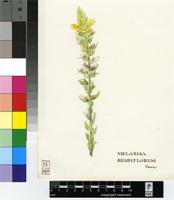
Name
Identification
Melasma sessiliflorum (Vahl) Hiern [family OROBANCHACEAE ]
Related name
- Melasma sessiliflorum
Flora
Entry for MELASMA sessiliflorum Hiern [family SCROPHULARIACEAE]
Herbarium
Royal Botanic Gardens, Kew (K)
Collection
Flora Capensis
Resource Type
Reference Sources
Entry From
Flora Capensis, Vol 4, page 121, (1904) Author: By W. P. HIERN, F.R.S.
Names
MELASMA sessiliflorum Hiern [family SCROPHULARIACEAE], Cat. Afr. Pl. Welw. i. 767
Gerardia sessiliflora Vahl [family ], Symb. Bot. iii. 79.
Rhinanthus scaber Thunb. [family SCROPHULARIACEAE], Prodr. 98, and Fl. Cap. ed. Schult. 458.
Bartsia scabra Spreng. [family SCROPHULARIACEAE], Syst. Veg. ii. 773.
Glossostylis capensis Benth. [family ], Scroph. Ind. 50, and in Hook. Comp. Bot. Mag. i. 212; Drège, Zwei Pflanzengeogr. Documente, 72, 106, 128, 151, 188; Krauss in Flora, 1844, 832; Harv. Gen. S. Afr. Pl. ed. i. 251.
Alectra melampyroides Benth. [family SCROPHULARIACEAE], in DC. Prodr. x. 339; Marloth in Engl. Jahrb. x. 254, not of O. Kuntze.
Alectra sessiliflora O. Kuntze [family SCROPHULARIACEAE], Rev. Gen. Pl. ii. 458.
Nigrina sessiliflora O. Kuntze [family SCROPHULARIACEAE], l.c. iii. ii. 237, partly.
Information
an erect herb, simple or loosely branched, glandular-hispid or nearly glabrous, annual, deep green in the living state, dusky when dry, 2–24 in. high or more, subparasitical; root saffron-yellow; stem or branches leafy, tetragonal; leaves triangular-ovate or lanceolate, obtuse, acute or acuminate at the apex, subtruncate or abruptly narrowed at the sessile or subsessile base, scabrid, rather thick, brittle, more or less coarsely toothed or denticulate or incise-dentate, sub-5-nerved, opposite, subopposite or alternate, mostly exceeding the internodes but sometimes shorter, 1/4–1 1/2 in. long, 1/6– 3/4 in. broad; flowers axillary or spicate, subsessile, usually numerous, about 1/2 in. long; spikes terminal; bracts sublinear or subulate, glabrous or ciliate, about 1/6– 1/5 in. long; calyx about 1/4 in. long, 5-cleft, campanulate, sparingly pilose outside, glabrous within; tube tetragonal, bibracteolate at the base; lobes lanceolate, ovate-acuminate or subdeltoid, acute, ciliate, about 1/6 in. long; corolla galeate-bilabiate, veined, bright golden-yellow or dull yellowish, red on the nerves, 5-cleft, glabrous; lobes obtuse, 3 lower larger than the others; stamens 4, didynamous or rarely 5 with the fifth shorter than the rest, glabrous or nearly so, the longer about equalling the corolla-tube; anther-cells usually apiculate at the lower end; ovary glabrous; style exceeding the stamens, somewhat thickened and bent above; stigma recurved, lingulate-oblong, somewhat flattened; capsules ovoid or subglobose, about 1/4 in. long; seeds numerous. null
Range
Also in Tropical Africa and Madagascar.
Distribution
CENTRAL REGION Graaff Reinet Div.; Portlock, Bowker, 7!COAST REGION , ascending to 2000 ft.: Clanwilliam Div.; Blue Berg, Drège. Tulbagh Div.; by Tulbagh Waterfall, Ecklon & Zeyher, 431! Tulbagh Kloof, Krauss! Worcester Div.; Hex River Mountains, Rehmann, 2698! Paarl Div.; Drakenstein Mountains, Bolus, 4063! Knysna Div.; Zitzikamma Forest, Krauss, 1641. Cape Div.; hills and flats near Capetown, Thunberg! Bowie! Ecklon & Zeyher, 163! Wolley Dod, 418! Bolus, 3806! Harvey, 212! 523! Drège, 130 a! Kuntze, Bunbury, 152! Uitenhage Div.; between Vanstaadens Berg and Bethelsdorp, Drège. Port Elizabeth Div.; Krakakamma, Burchell, 4546! Albany Div.; near Grahamstown, MacOwan, 454!EASTERN REGION , between 100 and 2500 ft.: Tembuland; Bazeia, Baur, 139! Pondoland; Fakus Territory, Sutherland! near St. Johns River, Drège, 130 d! Griqualand East; near Clydesdale, Tyson, 2785! and in MacOwan & Bolus, Herb. Norm., 1219! Natal; near the Umlaas River, Krauss, 168! Coastland, Sutherland! near Durban, Wood, 142! and without precise locality, Gueinzius, 512! Cooper, 2900! Gerrard, 291!KALAHARI REGION Griqualand West; Groot Boetsap, Marloth, 1001. Transvaal; Granite ridges near Barberton, Galpin, 1302! near Lydenburg, Wilms, 1090!SOUTH AFRICA without locality, Zeyher, 3521!
Notes
There is a dye in the root, given out to spirits of wine; it resembles gallstone. (Harvey, MS. on back of coloured drawing in Herb. Kew). O. Kuntze, Rev. Gen. Pl. iii. ii. 237–238, unites this species with M. indicum, and refers specimens with the leaves narrowed at the base to a form which he calls subpetiolata; without examining his specimens it is impossible to assign them with certainty to their proper species.