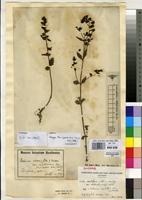
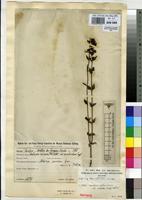
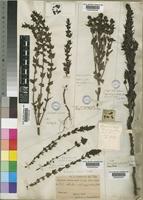
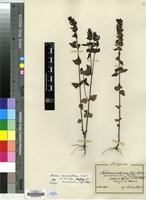
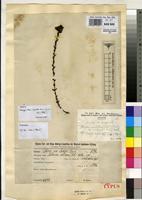
an erect herb, simple or branched above, scaberulous, annual, dusky when dried, 5–15 in. high; stem and branches hispid with whitish spreading hairs, leafy, tetragonal, 5 leaves opposite or subopposite, ovate or ovate-lanceolate, obtuse or acute, shortly wedge-shaped or subtruncate at the sessile or subsessile base, toothed chiefly along the lower half, scabrid above, hispidulous or nearly glabrous beneath, sub-5-nerved, 1/4–1 in. long by 1/5– 1/2 in. broad or the lowest smaller; each tooth subglandular at the tip; flowers in the axils of the upper leaves, forming terminal leafy or bracteate spikes, numerous, subsessile, 1/3– 1/4 in. long; spikes dense above, 1–2 1/2 in. long; bracts or floral leaves mostly 3/8– 5/8 in. long; bracteoles sublinear or subulate, 1/6– 1/4 in. long, hispid-ciliate; calyx loosely campanulate, more or less hispid-pubescent, 1/4– 1/3 in. long, 5-cleft, bibracteolate; lobes ovate, acuminate; corolla yellow, veined; stamens didynamous; longer filaments bearded with long hairs at least at their apex about the insertion of the anthers; anther-cells, apiculate at the lower end; style elongated, the oblong-lingulate stigma bent downwards. null