JSTOR Global Plants Home
  • Home
  • Browse
  • About
  • Access
  • Account
    • Saved Items
    • Profile
  • Log in

Global Plants

Skip to Main Content
  • JSTOR Global Plants Home
  • Global Plants

    • Browse
    • About
    • Access
    • Account
      • Saved Items
      • Profile
Log in
  • Browse
  • About
  • Access
  • Account
    • Saved Items
    • Profile
Advanced Search

Compilation
Maytenus procumbens

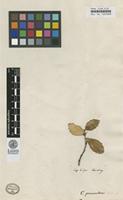
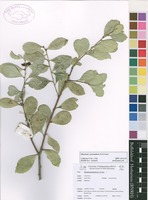
2 Images see all

Type of Celastrus procumbens L.f. [family CELASTRACEAE]
Filed as Maytenus procumbens (L.f.) Loes. [family CELASTRACEAE]
Previous
Next

Name

Identification
Celastrus procumbens L.f. [family CELASTRACEAE ] (stored under name); Verified by Not on sheet, Maytenus procumbens (L.f.) Loes. [family CELASTRACEAE ] Verified by Not on sheet,
Related name
  • Celastrus procumbens
  • Maytenus procumbens

Flora

Entry for Maytenus procumbens L.f. Loes. [family CELASTRACEAE]
Herbarium
Royal Botanic Gardens, Kew (K)
Collection
Flora Zambesiaca
Resource Type
Reference Sources
Entry From
FZ, Vol 2, Part 2, page 355, (1966) Author: N. K. Robson
Names
Maytenus procumbens L.f. Loes. [family CELASTRACEAE], in Engl. & Prantl, Nat. Pflanzenfam., ed. 2, 20b: 140 (1942). — Marais in Bothalia, 7: 383 (1960). Type from S. Africa (Cape Prov.).
Celastrus procumbens L.f [family CELASTRACEAE], Suppl. Pl.: 153 (1781). — Sond. in Harv. & Sond., F.C.I: 457 (1860). Type as above.
Gymnosporia procumbens L.f. Loes. [family CELASTRACEAE], in Engl., Bot. Jahrb. 39: 169 (1906). — Davison in Bothalia, 2: 294 (1927). — Hutch., Botanist in S. Afr.: 668 (1946). Type as above.
Information
Shrub or small tree up to 6 m. high, sometimes bushy or scandent or drooping or ± procumbent (in S. Africa), unarmed, glabrous, without latex; branches lined when young, becoming terete. Leaves not fasciculate, petiolate; lamina pale green, concolorous, (1)3–6·6 × (1)1·3–3·1(4) cm., oblong or elliptic to obovate or oblanceolate, acute to obtuse or rounded at the apex, with margin reflexed, indurated, bearing 3–5 spinulose glandular denticles on each side or subentire, cuneate-angustate at the base, coriaceous, with c. 6 lateral nerves prominent on both sides or obsolete; petiole (1·5)2–4 mm. long. Cymes fasciculate, sessile, in axil of foliage leaves; pedicels 3–10 mm. long, articulated c. 1/5–1/3 above the base; flowers c. 2–10 in each fascicle, 3–4 mm. in diam. Sepals 5, unequal, 1–1·5 mm. long, ovate, rounded. Petals white, 1–2(3) mm. long, oblong to elliptic, sessile, with margin subentire, ± crisped. Stamens 5, with filaments c. 1 mm. long, slightly flattened, inserted within the outer margin of the disk. Disk subentire, flat except for thin free upturned margin. Ovary 3-locular, subglobose, c. 1/3-immersed in the disk; style almost absent; stigma capitate or very shortly 3-lobed. Capsule bright yellow to orange or orange-brown, 4–5 mm. long, obovoid or subglobose to 3-gonous or shallowly 3-lobed, with lobes rounded or keeled, smooth, dry. Seeds orange-brown, completely enclosed by an aril.
Habitat
Woodland and scrub near the sea, on sandy soil
Altitude range
0–150 m.
150
0
Distribution
Mozambique M Inhaca I., N. coast, Melville fishing village, fl. 17.vii.1957, Mogg 27308 (K; PRE; SRGH).
Distribution (external)
Natal
E. Cape Prov
Notes
M. procumbens is a southern coastal derivative of the M. undata complex and is also closely related to M. lucida (L.) Loes. from the Cape region. It differs from the latter in having leaves with a denticulate to subentire (not entire) margin and from the rest of the M. undata complex by the combination of leaves with indurated margin and relatively few teeth and yellow to orange capsules. It may prove to be only subspecifically distinct from M. undata, in which case it would become the type subspecies.

Related Materials

  • Terms and Conditions
  • Privacy Policy
  • Cookie Policy
  • Cookie Settings
  • Accessibility
  • Help
  • Contact Us
  • Facebook
  • Twitter
ITHAKA

JSTOR is part of ITHAKA, a not-for-profit organization helping the academic community use digital technologies to preserve the scholarly record and to advance research and teaching in sustainable ways.

©2000-2026 ITHAKA. All Rights Reserved. JSTOR®, the JSTOR logo, JPASS®, Aluka®, and ITHAKA® are registered trademarks of ITHAKA.

╳